Editorial Team, Treasury Management International (TMI)
Turning Volatility into Action in Treasury
At Bank of America’s recent corporate treasury and Financial Institutions client events in Singapore, finance leaders explored how faster decisions, cleaner data, stronger controls, and deeper partnerships can turn volatility into action. Across both events, a consistent message emerged: resilience alone is no longer sufficient. Leading organisations are moving beyond resilience, actively redesigning their operating models, data foundations, and partnerships to unlock innovation and act with speed in an increasingly unpredictable world.
Disruption is reaching treasury from all sides. Geopolitics, real-time finance, fraud risk, and AI are changing how quickly treasury teams are expected to understand events, maintain control, and help their businesses decide what to do next.
That pressure provided a central thread to Bank of America’s 2026 Treasury Leaders Summit and Financial Institutions Forum in Singapore. Across both events, the discussion returned to faster decisions, cleaner data, stronger controls, and the confidence to act before uncertainty manifests as cost.
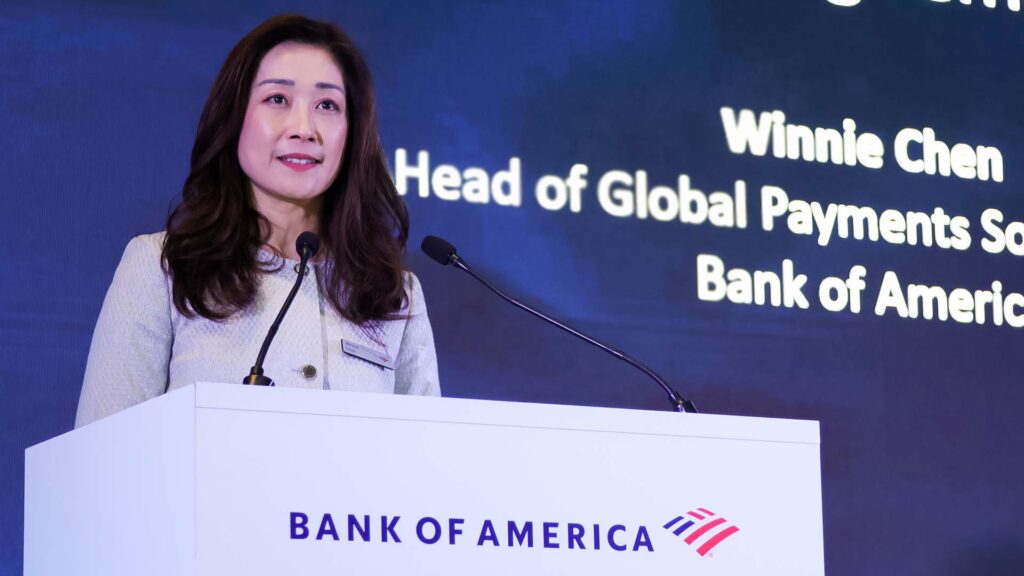
Winnie Chen, Head of Global Payments Solutions, APAC, Bank of America (BofA), told the audience that this pressure is recasting treasury’s role in the business. “Payment and treasury management has become the strategic infrastructure,” she said. “The era of payments being the back-office execution is over.”
Winnie Chen, Head of Global Payments Solutions, APAC, Bank of America
Liquidity, balance sheet management, supply chain resilience, compliance, fraud prevention, and disruption planning are increasingly being discussed together, because a weakness in one area usually soon spreads to another.
In Singapore, that wider remit was viewed through a distinctly regional lens. Asia’s technology export strength remains a source of resilience, but it sits alongside energy pressure, tariff uncertainty, divergent policy paths, and long-end yield volatility, all pulling on corporate decision-making at the same time.
For treasury teams, the macro picture quickly becomes part of the daily work. Higher energy costs, costlier buffers, refinancing risk, and volatile FX markets feed directly into working capital, liquidity, and hedging decisions.
Peter Guenthardt, Head of APAC Global Corporate & Investment Banking, BofA, said: “Volatility and uncertainty are the new normal. As a treasurer or a CFO, you must remain incredibly nimble.”
Nimbleness has to show up in daily decision-making as much as on the balance sheet. Treasury teams require clear 90-day priorities, pre-agreed triggers, liquidity buffers, and hedges that can be revisited as pricing and exposures move.
Martin Siah, Head of SEA Global Corporate Investment Banking & Head of APAC Estate, BofA, Peter Guenthardt, Head of APAC Global Corporate & Investment Banking, BofA and Claudio Piron Head of Asia Rates and Currencies Strategy BofA Global Research
Not so fast
Such a rhythm is difficult to sustain if the underlying treasury architecture is fragmented. Disconnected ERPs, bank portals, TMSs, and local processes create latency and reconciliation work, leaving teams without a timely view of cash, exposures, and obligations – visibility that is critical when decisions need to be executed quickly.
Neethi Shetty, Treasury Operations Manager, Atlassian, explained: “When you don’t have a clear or timely view of the global cash or exposures, or even obligations, it becomes really hard to make decisions.”
In practice, progress often comes from simplifying foundations—standardising processes, rationalising banking relationships, and strengthening governance—rather than adding new tools.
That discipline can be hard to replicate. Local treasury teams may face capital controls, reporting demands, or banking practices that make standardisation difficult. Each exception becomes part of the machinery and must be revisited when the business restructures, absorbs an acquisition, or changes platforms.
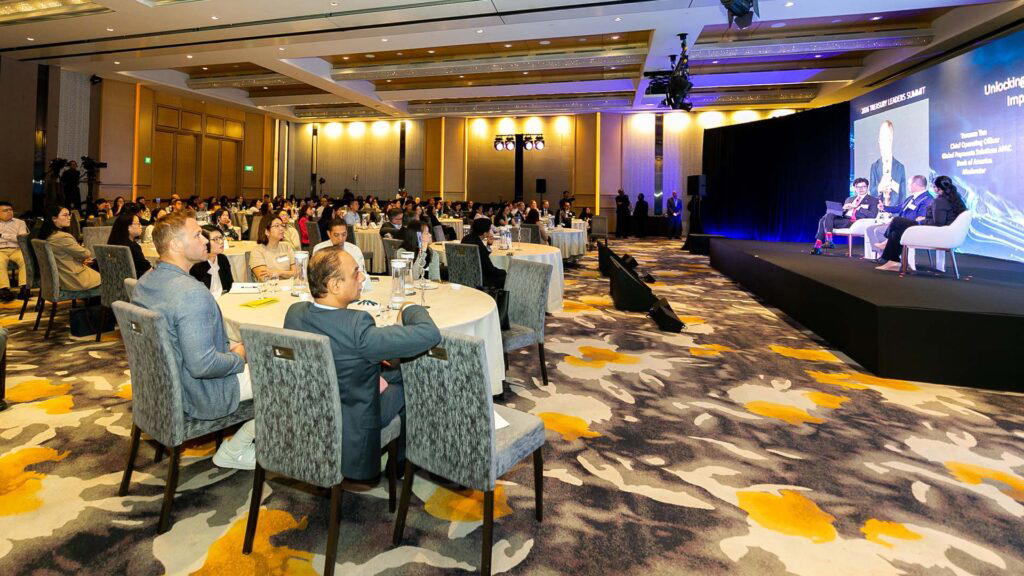
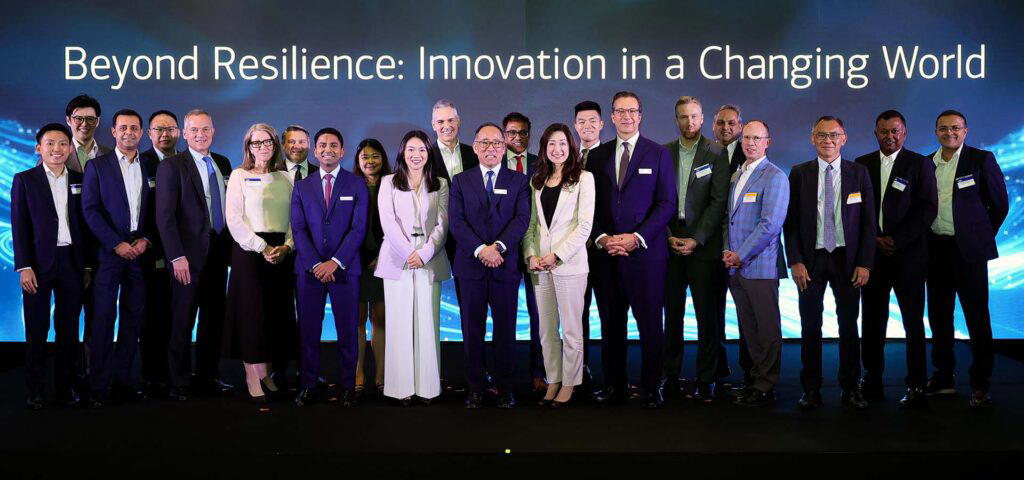
A curated gathering of senior corporate and FI leaders at Bank of America’s flagship annual client event.
AI raises the cost of weak foundations. While it can accelerate analysis, reporting, and pattern recognition, its effectiveness depends entirely on the quality and accuracy of underlying data. Without strong governance and clean data, AI tools may simply expose gaps more quickly rather than resolve them.
Treasury earns influence
Treasury’s influence ultimately turns on people as much as process. As CFOs pull treasury earlier into business change, the function’s value increasingly lies in turning data into choices, recommendations, and action.
Sophia Brissot, Chief Financial Officer Asia, Accor Group, said: “The expectation today is that the treasurers move away from just transactional and technical and acquire project management and change management skills.”
That skill set matters because treasury’s path to influence often runs through cross-functional work, from acquisitions to sustainability projects. Technical expertise may get treasury into the room, but project leadership is what makes the function visible beyond its traditional remit.
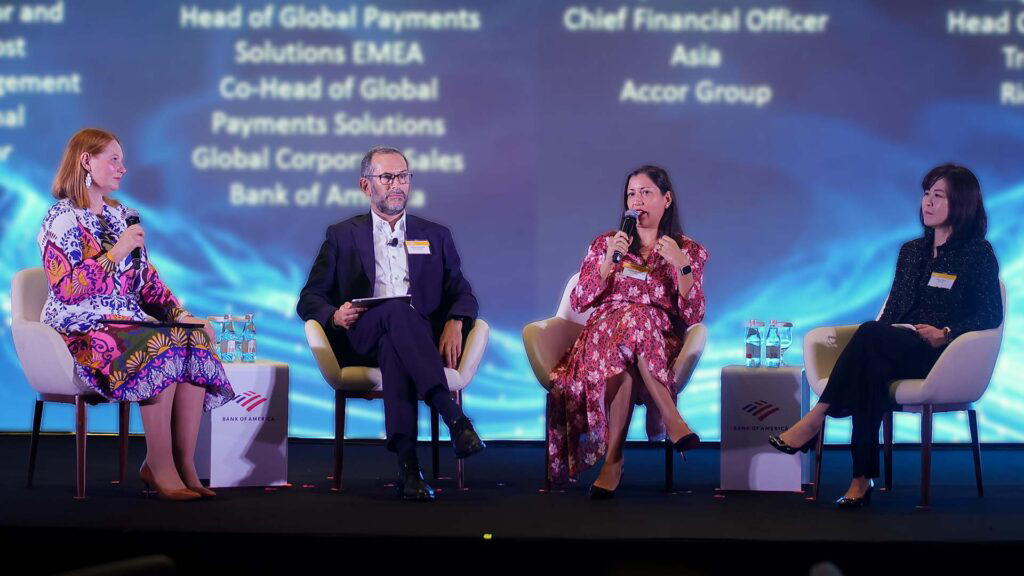
Eleanor Hill, Editorial Consultant TMI, Moderator, Matthew Davies, Head of Global Payments Solutions EMEA, Co-Head of Global Payments Solutions, Global Corporate Sales, BofA, Sophia Brissot, CFO Asia, Accor Group, Jingli Thoh, Head Commerical Treasury, Rio Tinto
Brissot added: “I was always raising my hand to lead new projects, because that gives you visibility and opens up your mind. You deal with other departments, other topics, and that’s how you grow.
That point is particularly tangible during corporate change. Following Rio Tinto’s recent $6.7bn acquisition of Arcadium Lithium, treasury and tax moved early on integration. The work required understanding how the acquired business operated and how people on both sides could build trust.
Jingli Thoh, Head Commercial Treasury, Rio Tinto, said: “Communication and building that relationship is what made our integration successful. When people are genuinely working together as a team, integration can succeed.”
Treasury influence also depends on relationships being built before they are urgently needed. Matthew Davies, Head of Global Payments Solutions EMEA and Co-Head of Global Payments Solutions Global Corporate Sales, BofA, said: “What differentiates a good team is having pre-wired relationships across the organisation, so whether that’s FP&A, tax, procurement, supply chain, the frontline business units, everyone knows that the treasury team is plugged in.”
Those relationships give treasury room to act when conditions change, but influence still depends on what teams do with that access. Cleaner data and sharper tools will help, but the next stage of treasury leadership will rest on the human ability to interpret, challenge, and decide. As Thoh put it, teams need “critical thinking and first-principles problem solving.”
Bank of America’s Treasury Leaders Summit and Financial Institutions Forum, Singapore, May 2026
Getting practical with digital trade
From Bank of America’s perspective, trade finance represents one of the clearest opportunities for innovation, shifting from fragmented, paper-based processes to digitally connected ecosystems. Digitisation, however, depends on multiple interdependent factors, including data, legal certainty, bank connectivity, and trust between parties operating in different systems and jurisdictions. Even as legal frameworks evolve, the bill of lading remains one of the most complex documents to digitise given its role as a negotiable instrument of title.
At the same time, the industry’s pursuit of perfect standardisation is increasingly becoming a barrier to progress. Drawing on decades of experience with electronic bills of lading (EBLs), the practical test is less about achieving an ideal end state and more about whether digital solutions can reliably replicate current outcomes. Where that threshold is met, organisations are beginning to move forward, shifting the focus from waiting for perfection to delivering tangible progress.
Banks can add value by helping a fragmented trade ecosystem communicate more efficiently. EBL platforms, logistics providers, payment rails, ERPs, and bank channels all play different roles in the process. In open account trade, the value lies in removing paper and latency from invoice approval and financing.
One BofA open account payment process previously handled around four million paper documents a year before being rebuilt around APIs, rules engines, and collaboration tools.
Duncan Lodge, Global Head of Supply Chain Finance and EMEA Head of Trade, BofA, said: “We’ve seen invoice approval times go from weeks to, in some cases, seconds.”
A tokenised invoice could also carry metadata on buyer acceptance, payment undertakings, insurance status, ownership, and dilution history, making the receivable easier for financiers and investors to assess.
Control at speed
FIs face a market-level version of the same challenge: making money, data, and risk move faster without losing trust. In cross-border value movement, payment and settlement rails such as correspondent banking, stablecoins, tokenised deposits, and CBDCs are developing in parallel, making interoperability and governance as important as speed.
Rich Clow, Head of Payments Innovation, BofA, said: “You’re going to see a mix by industry and risk appetite. It’ll be the right tool for the job.”
For institutions, the challenge is to build infrastructure that supports coexistence without introducing further fragmentation. AI raises a parallel question of execution. Once pilots begin to touch real workflows, firms need the data foundations, governance, and operating discipline to make them scalable.
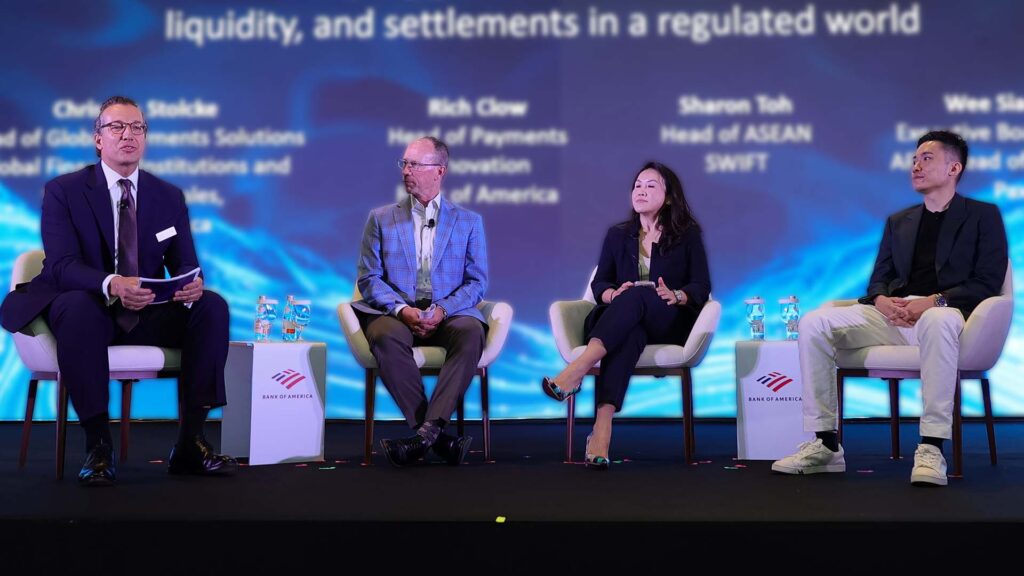
Christian Stolcke, Head of Global Payments Solutions, Global Financial Institutions and Private Bank Sales, BofA, Rich Clow, Head of Payments Innovation, BofA, Sharon Toh, Head of ASEAN, Swift, Wee Siang Lee, Executive Board Director APAC, Head of Compliance, Paxos
Namrata Jolly, Managing Director, Head of Asia Financial Services Industry, Microsoft, said: “The conversation has shifted beyond proving AI’s value and identifying isolated use cases, to a focus on operationalising AI at scale and defining the operating model required to support the organisation needs.”
For FIs, that discipline matters. A long list of pilots can create the impression of progress while leaving the business unchanged. A stronger approach is to choose a small number of core processes, re-engineer them properly, and build the governance to match.
The partnership test
Future readiness cannot be built in isolation. Treasury data, trade digitisation, payment rails, and AI become useful only when teams, platforms, banks, and market infrastructure can work together under pressure. The next phase of resilience will depend on whether those connections hold across jurisdictions and use cases.
“Financial institution clients are our partners, not just clients,” said Chen. “None of us can build every capability in every jurisdiction, or serve corporates as they expand internationally, without complementing and helping each other come up with the best ideas and solutions.”
For treasury leaders and FIs alike, the lesson is practical. Volatility will keep testing the system. The advantage will belong to those who can connect the right data, people, and partners quickly enough to decide, act, and keep the business moving forward. This is what it means to move beyond resilience, translating complexity into coordinated action through innovation.