
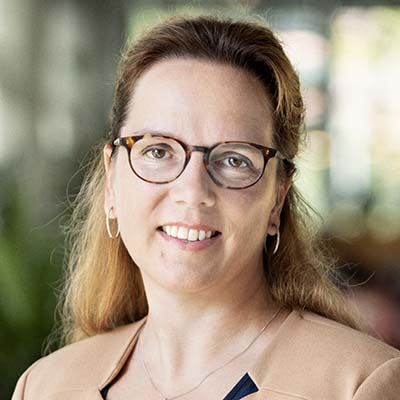
- Annelinda Koldewe
- Global Head of Payments and Cash Management, ING
“Get your hands dirty.” That is not a command usually heard inside the HQ of a major bank, but it was one of the main messages for the audience at ING’s Orange live – The Future of Payments event. Here, Annelinda Koldewe, ING’s Head of Payments and Cash Management reflects on the bank’s recent flagship webinar.
With plenty of talk about worldwide payments becoming faster and increasingly borderless, much of the attention is focused on tokenised assets, blockchain and, in particular, stablecoins. At ING, we wanted to bring that conversation to life at the Orange live event on March 19, inviting leading experts to discuss the latest developments.
“The conversation about tokenised assets has entered boardrooms and reached political leaders faster than anyone could have imagined 10 years ago,” said Neha Narula, Director of the Digital Currency Initiative, part of the MIT Media Lab. Adoption and application across a broad range of use cases beyond speculation, however, remain limited so far. Speaking to an audience, both in person at ING’s HQ and virtually around the world, she noted that while the topic is complex and the future is still uncertain, even sceptics cannot simply wash their hands of it and say it won’t happen.
Seeking the biggest bang for your buck
In the past 12 to 18 months, momentum has accelerated in a clear direction: the future of payments lies in optionality. How money moves globally will change, but there won’t just be one route. Conversations often explore whether stablecoins might play a bigger role than traditional rails, although that is not necessarily an either-or situation. The same holds true for the choice between tokenised deposits and stablecoins as the digital asset of choice: there is no clear winner between the two.
The real question is what each method of moving value offers, and where you get the biggest bang for your buck. As Narula stressed, you need to get your hands dirty with the technology and think about how it will strategically apply to your business.
The complexity of the tokenised world is no reason not to try to understand what is happening, added Marieke Flament, an independent member of the supervisory board of Qivalis, the euro-denominated stablecoin initiative backed by leading European banks, including ING.
“I’ve been in technology a long time and I’ve never seen the speed and pace of change that we see today,” she told the audience. She noted a strong sense of urgency, especially in Europe, that we need to get moving. The greatest opportunity in Europe is the introduction of euro-denominated stablecoins, given that 99% of stablecoins are dollar-denominated.
As new payment models emerge, regulation is also taking shape, spearheaded by Mairead McGuinness, former EU Commissioner responsible for the Markets in Crypto-Assets regulation (MiCA). Regulation ensures consumers and businesses alike can trust that their money – in whatever form – is safe. Trust, she said, is easily broken, as seen during the 2008 global financial crisis, and slow to rebuild. McGuinness said that creating the regulation felt like trying to predict the future without knowing what tomorrow would look like – yet it was essential for building trust around tokenised assets.
A key factor is the recognition that tokenising money, especially in payments, has a clear future. The way we move money around the world will change. Banks such as ING are exploring these developments because our responsibility goes far beyond simply getting money from A to B. We cannot allow complexity to hold us back and we owe it to our customers to make sense of how payments evolve. As Narula urged us to do, we at ING are getting our hands dirty.
Did you miss Orange live? You can watch the full event here: or listen to the podcast on Spotify or Apple Podcasts