

- Eliane Eysackers
- Director, Zanders

- Mark Sutton
- Senior Manager Corporate Treasury Advisory, Zanders
From Idle Cash to Programmable Liquidity
As conversations around tokenisation move up the agenda, Eliane Eysackers and Mark Sutton, Zanders, examine the topic through the lens of both the treasurer and CFO. The technology is offering corporates the opportunity to redesign how treasury manages money, liquidity, and payments.
Corporate treasury has spent decades building increasingly sophisticated processes to move, concentrate, invest, and protect cash. Yet much of the underlying infrastructure remains based on assumptions from an earlier era: banking hours, batch processing, multiple ledgers, intermediary chains, manual reconciliation, and settlement cycles that introduce time, cost and risk. Tokenisation could fundamentally change that model.
Tokenisation is the digital representation of money or financial assets on a programmable ledger. For corporate treasury, three developments are particularly important: tokenised deposits, regulated stablecoins, and tokenised securities. Together, they point towards a future in which money and financial assets can move continuously, be exchanged atomically, and be governed by programmable rules. The significance is therefore not simply that treasury will use a new form of digital asset. The real opportunity is to redesign how treasury manages money, liquidity, and payments.
What is changing?
Today, a corporate payment typically involves several distinct processes: the treasury initiates a payment, the bank processes it, multiple systems exchange messages, accounts are updated, settlement takes place, and the transaction is subsequently reconciled. Cross-border transactions can add correspondent banks, FX, cut-off times, and additional settlement steps.
Tokenisation has the potential to bring these processes much closer together. The Bank for International Settlements (BIS) describes tokenisation as integrating messaging, reconciliation, and settlement on programmable platforms, creating the possibility of atomic settlement and new forms of programmable transactions[1].
For corporate treasury, three forms of tokenised value are particularly relevant (see fig 1).
Fig 1
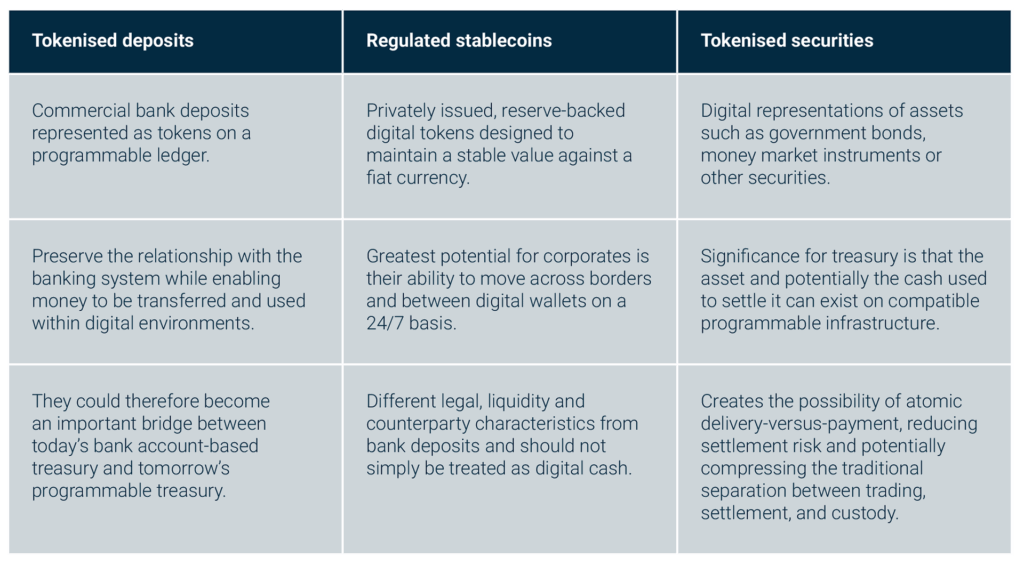
The important point is that these technologies are complementary rather than competing solutions.
Why is tokenisation so important for treasury?
The strategic question is not whether a token is better than a bank account. It is whether programmable money and assets can remove structural friction from corporate treasury processes.
Consider today’s liquidity management. A treasury may hold hundreds of bank accounts across multiple jurisdictions, with balances consolidated periodically into a TMS[2] or ERP[3]. Cash concentration depends on banking arrangements, cut-off times and local payment infrastructure. Excess liquidity may then be invested through separate processes, while collateral movements and securities settlement operate through another set of infrastructures. Tokenisation creates the possibility of a more continuous model (see fig 2).
Fig 2
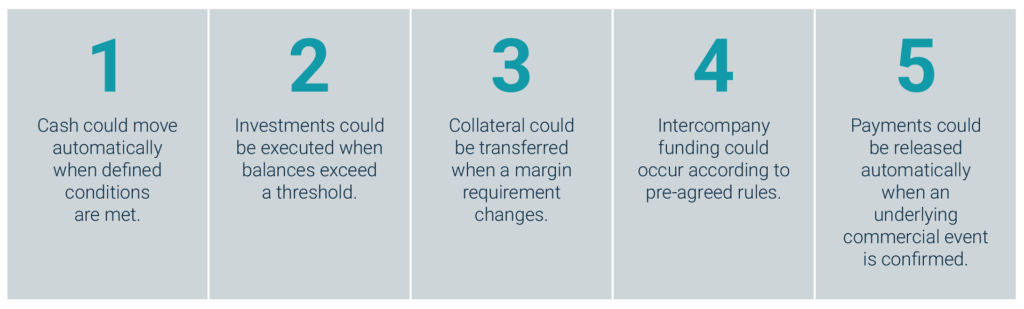
The opportunity is therefore not simply faster payments. It is the transition from treasury that processes transactions to treasury that orchestrates liquidity through rules.
This aligns with the emerging direction of the financial system. The BIS has argued that tokenised central bank money, commercial bank money, and securities could form the foundations of a next-generation monetary and financial system¹. The European Central Bank (ECB) similarly sees tokenisation as a way to integrate processes such as messaging, reconciliation, and settlement while maintaining central bank money as the settlement anchor[4].
The CFO conversation every treasurer should have
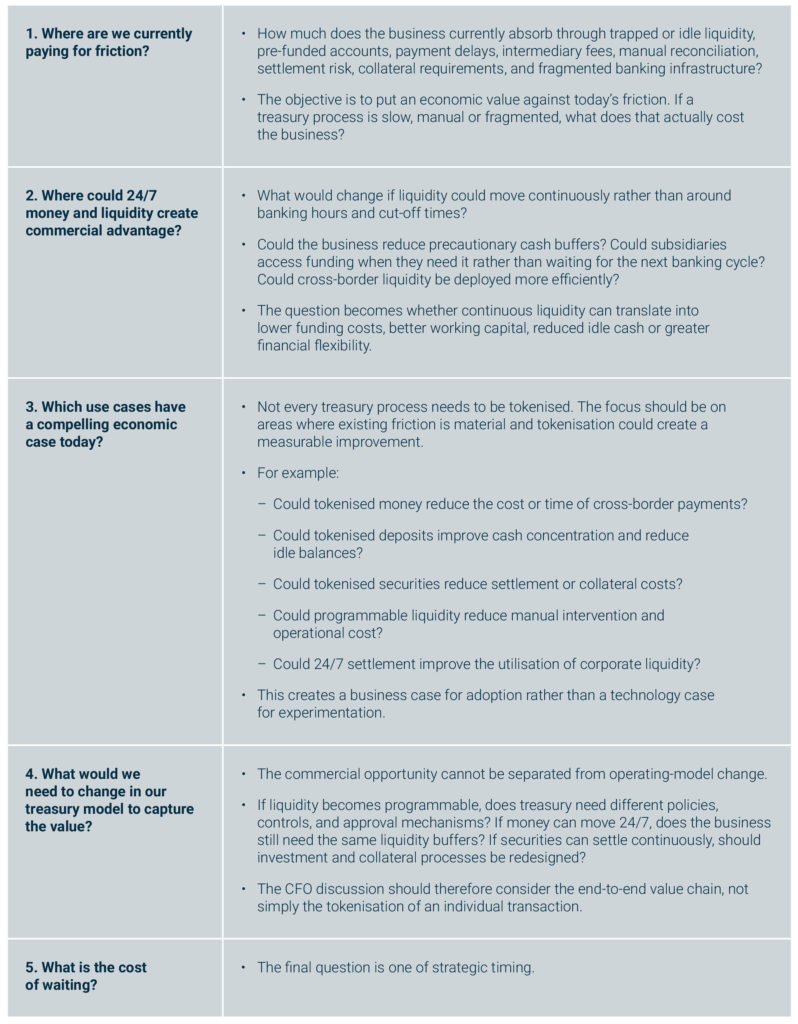
The conversation between the treasurer and CFO should not begin with blockchain, digital assets or technology. Tokenisation should be treated first as a commercial opportunity for treasury, with technology providing the infrastructure to deliver it. The starting point is therefore not “Should we adopt tokenisation?” but “Where could tokenised money and assets materially improve the economics, resilience or agility of our treasury model?”
That leads to a different and more strategic CFO dialogue, with every treasurer asking the following (see fig 3).
Fig 3
The CFO ‘so what?’
Looking through a CFO lens, the below ultimately reframes tokenisation around four commercial outcomes (see fig 4).
Fig 4
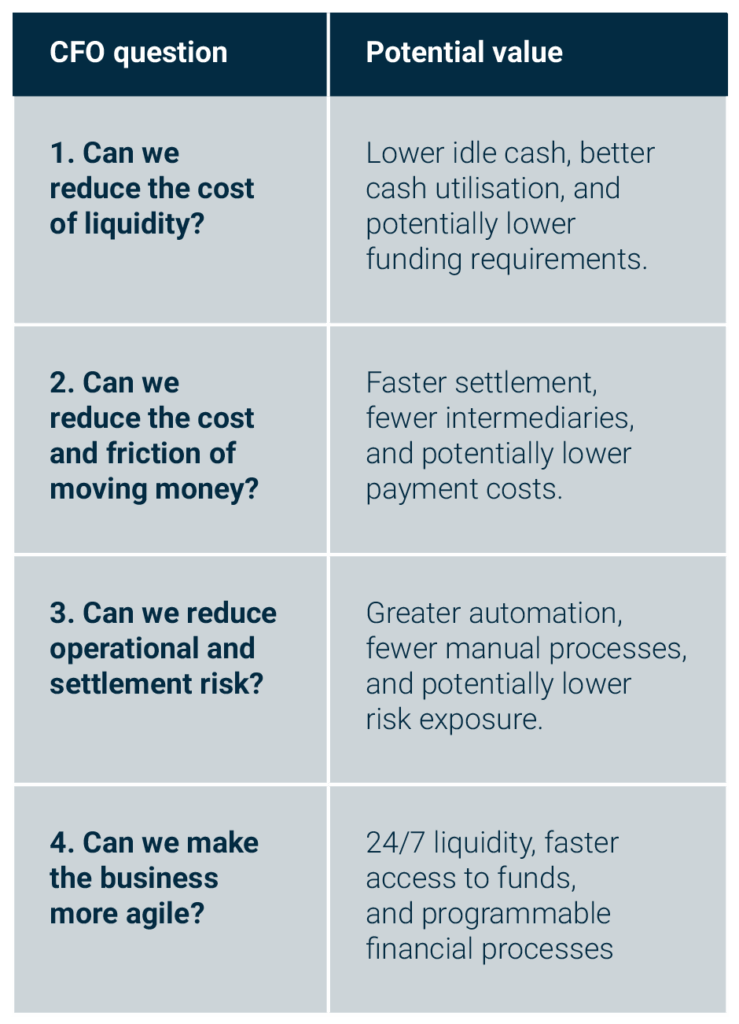
The CFO should ultimately be able to answer the key question: “What measurable business value would we create by adopting tokenised money or assets, where does that value sit, and what would prevent us from capturing it?”
That is a fundamentally different conversation from asking whether the company is ready to adopt blockchain.
The priority use cases
1. Cross-border and intercompany payments
Regulated stablecoins and tokenised deposits could enable corporate value to move continuously across jurisdictions, particularly where traditional correspondent banking creates delays and multiple processing steps.
So what? Treasury could reduce the amount of liquidity that needs to be positioned in advance simply to accommodate payment timing. The greater benefit is potentially moving from pre-funded liquidity towards on-demand liquidity.
However, currency, regulation, wallet governance, counterparty risk, and conversion into local fiat remain critical considerations.
2. Cash pooling and liquidity concentration
Imagine a treasury environment where subsidiaries hold tokenised deposits and automated rules continuously monitor balances. When an entity falls below a defined threshold, funding can be triggered; when another exceeds its liquidity requirement, excess funds can be transferred or invested.
So what? Cash concentration becomes closer to a real-time liquidity orchestration process rather than an end-of-day or intraday banking exercise. This reduces idle cash and improves visibility.
3. 24/7 liquidity, investment, and collateral optimisation
Today, treasury investment and collateral management are constrained by market hours, settlement cycles, manual processes and the need to maintain liquidity buffers. Cash that is temporarily surplus may sit uninvested because the next investment opportunity, settlement window or liquidity requirement does not align with the treasury operating cycle. Similarly, collateral movements and margin calls can require manual intervention across multiple counterparties and systems. Tokenised securities could fundamentally change this dynamic.
Treasury could hold tokenised money market instruments, government securities or other eligible assets on programmable infrastructure and combine them with tokenised money. Smart contracts could then automatically execute defined actions when liquidity or collateral conditions change.
For example, if a margin requirement subsequently increases, the relevant tokenised asset could be automatically mobilised or transferred to meet the collateral requirement, subject to predefined limits and approvals. When liquidity is released, assets could potentially be reinvested without waiting for the next traditional settlement window.
So what? The opportunity is to move from periodic investment and reactive collateral management to continuous liquidity optimisation. The strategic shift is significant. The investment portfolio is no longer simply where surplus cash is parked; it becomes an actively programmable liquidity pool that can continuously respond to the company’s funding and collateral requirements.
4. Programmable treasury
Perhaps the most transformative use case is not a particular payment or investment, but the ability to encode treasury policies into execution. For example: “If operating cash exceeds the approved liquidity buffer, invest the excess in an approved tokenised instrument, provided the counterparty exposure remains within limit.” Today this is a policy followed by people and systems. In a tokenised environment, parts of the policy could potentially become executable.
So what? Treasury moves from monitoring and manually initiating actions towards automated execution within defined governance parameters.
The risks and considerations
The opportunity should not obscure the fact that tokenisation introduces new risks.
- Interoperability: is perhaps the most important. A tokenised deposit issued by one bank may not automatically be usable elsewhere. If every bank creates its own closed environment, treasury could replace today’s fragmentation with a new form of digital fragmentation. Interoperability is noted as one of the 12 core principles defined by the Tokenized Cash Management Advisory Group (TCMAG)[5], which aims to amplify the voice of the corporate around treasury tokenisation.
- Counterparty and liquidity risk: also remain fundamental. A tokenised deposit is still ultimately a bank liability. A regulated stablecoin introduces a different issuer and reserve structure. The tokenisation of an asset does not eliminate the underlying economic risk.
- Legal and regulatory treatment: must be clear across jurisdictions, particularly for cross-border payments, custody, accounting, tax, and securities ownership.
- Technology and operational resilience: become increasingly important. Wallets, private keys, smart contracts, digital identity, cyber controls, and network availability become part of treasury’s risk environment.
Finally, governance must evolve. If treasury begins automating decisions, the organisation needs clear controls over who can create, approve, amend, and stop automated liquidity rules.
What should treasurers do now?
The answer is not to wait for tokenisation to become mainstream. Nor is it to rush into production.
Treasurers should start with readiness and targeted experimentation.
- Map the existing friction points across payments, liquidity, investments, collateral, and intercompany funding.
- Assess which processes are most suited to 24/7 programmable execution.
- Understand the different characteristics of tokenised deposits, regulated stablecoins, and tokenised securities rather than treating ‘digital money’ as a single category.
- Engage banks, TMS/ERP providers and technology partners around interoperability, custody, connectivity, and settlement.
- Run controlled simulations or proofs of concept. Test the economics and operating model, not just whether the technology works.
The objective should be to answer a practical question: “If tokenised money and assets become scalable over the next three to five years, what would we need to change in our treasury operating model?”
The future is likely to be hybrid
Tokenisation is unlikely to replace today’s treasury infrastructure overnight. The more realistic future is a hybrid treasury, where conventional bank accounts, payment rails, and securities infrastructure coexist with tokenised deposits, regulated stablecoins, and tokenised assets. That transition could nevertheless be profound.
The future treasury may manage liquidity continuously rather than periodically, execute payments according to programmable rules rather than cut-off times, and manage money and investments on increasingly connected infrastructure. The strategic prize is therefore bigger than faster settlement. It is the possibility of making money, liquidity and payments programmable and continuous.
For the CFO, the question is not whether the company should adopt blockchain. It is whether the treasury model built around today’s constraints will remain competitive in a world where liquidity can move 24/7, assets can settle atomically and treasury policies can increasingly be executed automatically. For the treasurer, that makes tokenisation less a technology project and more a question of future treasury design.
The organisations that begin exploring that question now will be better positioned to decide where tokenisation genuinely creates value – and where the traditional model remains the better answer.
Notes
- Bank for International Settlements (BIS) Annual Economic Report 2025.
- Treasury Management System (for example, FIS, Kyriba, ION).
- Enterprise Resource Planning (for example SAP, Oracle, Microsoft Dynamics).
- Official Eurosystem/European Central Bank (ECB) policy speeches and exploratory work on DLT settlement integration, such as the Central Bank of Ireland’s Finance in Transition Speech and ECB/Eurosystem statements on DLT and central bank money.
- https://www.tcmag.org/