Editorial Consultant, Treasury Management International (TMI)
Treasurers Can’t Afford to Either
Over 130 treasury professionals – including young talent – gathered at BNP Paribas’ offices in the heart of Paris to mark ten years of the Journeys to Treasury initiative with a day of exploring the past, defining the present, and shaping the future. While the agenda stretched from 2016 to 2035, the underlying message was consistent: transformation is no longer coming, it’s already here and operational. In other words, the future is now.
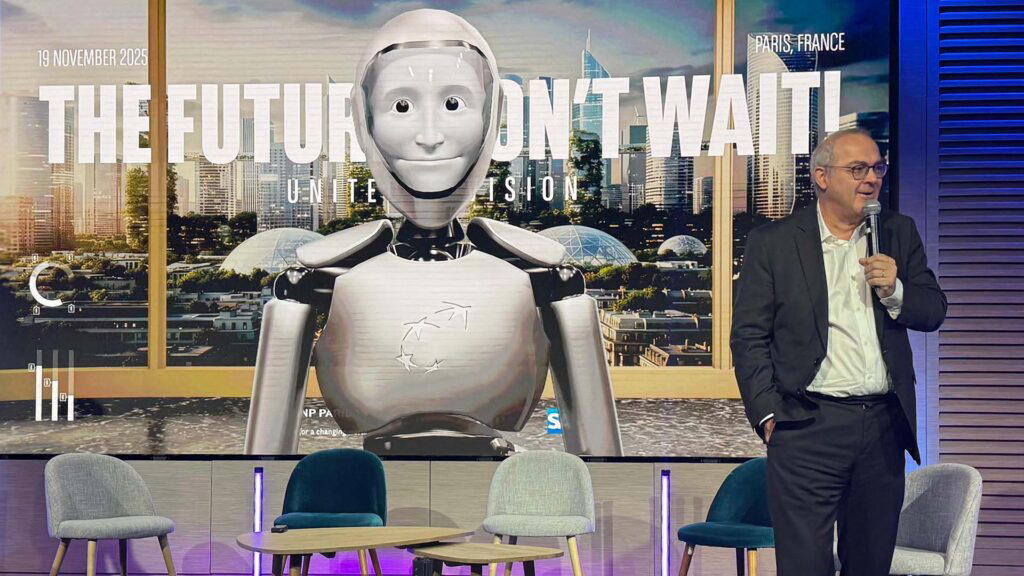
A few hours into ‘The Future Won’t Wait’ event, the atmosphere suddenly shifted. Max, the humanoid co-host who’d been offering commentary alongside moderator Fred Doazan, began to glitch. His voice fractured, movements slowed, and within moments he appeared to fail altogether.
Meanwhile, the bank’s typically calm and collected Head of Events, Issam Akel, pressed a hand to his earpiece and jogged up the auditorium steps calling for technical support. For a brief moment, no one was entirely sure what was going on, although a cyber-attack was soon suspected…
Of course, it turned out to be pure theatre! Well-acted drama to hammer the point home that in a world of real-time treasury, digital currencies and AI, the most strategic asset isn’t innovation itself, but continuity. This was a critical message repeated throughout the day, and reinforced by a look back at just how far technology has come in recent years, and where it will be going in the future. Alongside this, talent was also under the microscope, with a cross-generational audience and panel showcasing the need for a fresh approach to human intelligence as well as artificial intelligence.
Pierre Fersztand and Max
Key takeaways for treasury leaders
Resilience must be engineered, not assumed. Treasurers must test end-to-end resilience across payment chains, data dependencies and vendor ecosystems, rehearsing outage scenarios rather than relying on siloed business-continuity plans. As Isabelle Badoux, Head of Global Treasury Operations, Systems & Treasury Transformation at Sanofi reminded the room, “If you are no longer able to pay some critical suppliers, then the entire business is at stake.”
Uncertainty has become structural. Macro volatility, geopolitical shifts and fragmented regulatory regimes mean treasurers need to run multiple, parallel futures rather than rely on single-point forecasts. Isabelle Mateos y Lago, Chief Economist, BNP Paribas framed the current moment as an “interregnum” underscoring the need for judgement, scenario fluency and clear communication.
AI is moving from interpretation to orchestration. The next leap is prescriptive and agentic AI – intelligent systems capable of recommending or automating actions under human oversight. The value is not volume of output but cognitive relief, giving treasurers more capacity for strategic work. In doing so, AI is also supercharging embedded finance, with intelligence moving into the flow of activity itself to provide real-time, predictive and personalised decisioning.
Tokenisation and real-time infrastructure are reshaping liquidity. Digital assets are transitioning from proof-of-concept to regulated infrastructure. Tokenised deposits, smart contracts and atomic settlement promise on-demand liquidity and greater interoperability – a shift that will reconfigure treasury workflows and challenge old assumptions about forecasting, cut-offs and settlement windows.
Data is now the central nervous system of treasury. ISO 20022, API connectivity and real-time payment schemes have turned operational messages into strategic data assets. The quality, timeliness and security of this data will determine how far AI, forecasting, fraud detection and liquidity optimisation can go.
Skills are shifting rapidly. Strategic thinking has overtaken functional expertise as the top capability for future treasurers, with technology affinity rising sharply. The profession is becoming more interdisciplinary, blending finance, technology, risk and policy literacy.
Purpose and culture will shape future teams. Younger treasurers are motivated by meaningful work, ethical finance and cross-functional mobility. Succession planning therefore becomes cultural, not procedural – developing judgement, curiosity and flexibility, not just technical proficiency.
The future will not slow down – so readiness becomes an operating principle. From cyber resilience to tokenisation pilots, instant payments to AI-enabled decisioning, treasurers need to combine pragmatic execution with forward-looking experimentation. Preparedness can no longer wait. The time is now.
A decade in the rear-view
Indeed, after inspiring introductions from Pierre Fersztand, Global Head of Cash Management, Payments, Trade Solutions & Factoring, BNP Paribas and Aurélia Normand, Head of Global Transaction Banking, BNP Paribas CIB, the opening session of the conference, examined the years 2015 to 2025 – through the eyes of Journeys to Treasury (celebrating 10 years of the joint project between BNP Paribas, the EACT, PwC and SAP). This was a useful way to understand the extent to which cumulative change has reshaped the profession.
SAP’s Dr Arif Esa described the shift succinctly, stating that: “Behind every faster, more agile, more predictive treasury, there is a system, there is data, there is technology”. Here, he stressed how data has moved from being a by-product of treasury activities to a raw material.
Meanwhile, PwC’s Didier Vandenhaute highlighted trends visible in several consecutive corporate surveys conducted by the firm. While cash and liquidity have remained the defining priorities of the function, treasurers have also absorbed responsibilities that were traditionally beyond their perimeter, from ESG reporting to cyber oversight, he noted. He also pointed to the fact that the profession’s development has been continuous, yet often under-recognised.
EACT Chair François Masquelier mapped the same period through the lens of risk, arguing that volatility has become “systemic, not cyclical,” and that uncertainty now forms part of the structural environment rather than the exception to it. His call for treasurers to prepare for “multiple possible futures” rather than rely on prediction alone set the tone for later discussions.
At the same time, Bruno Mellado, Global Head of Payments & Receivables, BNP Paribas traced the evolution of payments, positioning 2015 as “the birth of anytime, anywhere treasury” and 2025 as the moment real-time became the norm.
Together, these threads presented the past decade not as a prelude but as the foundation upon which the next phase of transformation will build. Adding a useful corporate perspective here, a speaker from treasury and cash management within a global pharma company, reminded the audience that transformation is as much about people as it is about systems. He stressed that treasury must “own the change” rather than delegate it, and that adaptability remains essential. “Nobody likes change – that is the human condition,” he said, before urging teams to “keep the pace, keep the direction, be agile – always.”
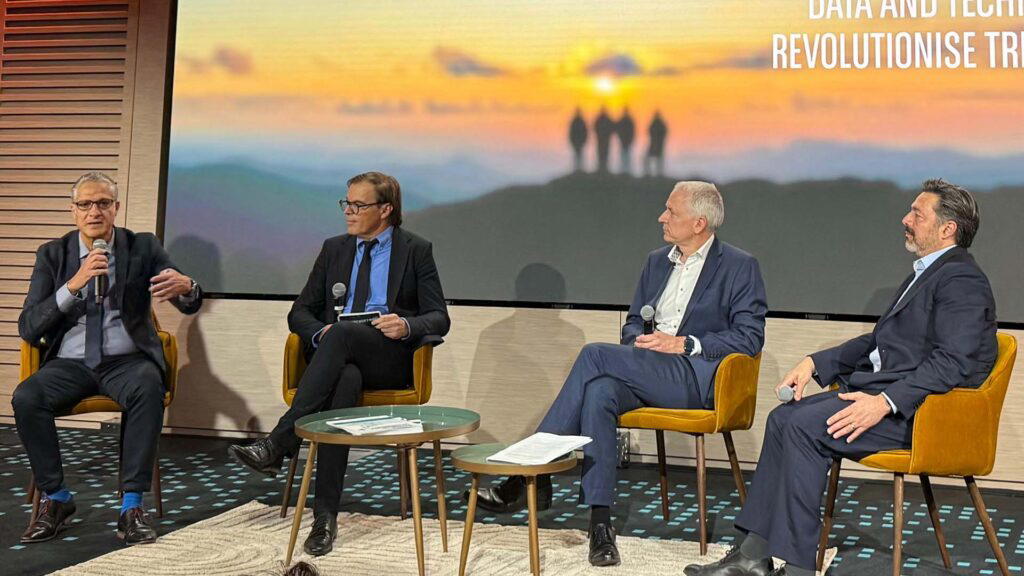
Dr Arif Esa, Francois Masquelier, Dider Vandenhaute and Bruno Mellado
Navigating the interregnum
Next, the horizon from 2025 to 2030 was framed with great expertise by Isabel Mateos y Lago, the bank’s Chief Economist, who invoked Italian philosopher, Antonio Gramsci, describing the present as an interregnum “between an old world that is gone and a new world that is struggling to be born.” Alliances, trade rules and monetary anchors that once offered predictability no longer behave as they did; in her view, “we know what we are leaving behind – we don’t know what the destination is.”
Despite that uncertainty, she pointed to a level of economic resilience that had surprised many forecasters, noting that in 2025 the global economy proved more robust than expected and that her baseline scenario sees that resilience continuing into 2026. Strong corporate and household balance sheets in Europe, supportive conditions in key industries and renewed investment momentum – particularly around AI and energy transition – are central to that view. Yet she also warned of “mammoth structural shifts” underway, from decarbonisation to digital assets, and the risk that geopolitical shocks could puncture that resilience quickly.
These macro perspectives dovetailed with a discussion on sustainability and regulation, where Nicolas Bouvier, Head of Sustainability for Transaction Banking EMEA, BNP Paribas, underlined that transition finance is no longer peripheral. “Treasurers have, by essence, a role to play in this fundamental change,” he believes. As do banks – by structuring funding to support decarbonisation and building frameworks that link liquidity with climate outcomes.
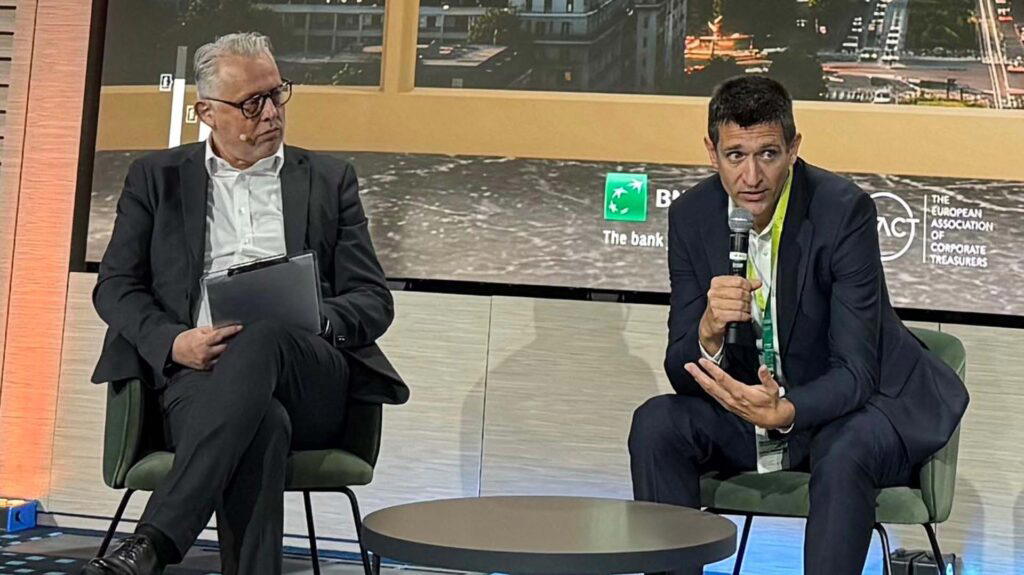
Fred Doazan and Nicolas Bouvier
Corporate reflections from Olivier Klaric, Senior Vice-President Finance, Treasury & Insurance at Sanofi, also complemented this macro outlook, highlighting how geopolitical fragmentation, heightened scrutiny and rising operational dependencies are reshaping the treasurer’s strategic mandate.
Across these exchanges ran a common thread: treasurers must increasingly act as interpreters of global forces for their organisations, translating complex external dynamics into operational and strategic decisions.
Continuity rehearsed, not assumed
Some of the day’s most practical lessons emerged from discussions on operational resilience. For example, Isabelle Badoux, Head of Global Treasury Operations, Systems & Treasury Transformation at Sanofi, emphasised that treasury functions manage liquidity “on a day-to-day basis”; without that capability, business continuity collapses rapidly.
Her critique of traditional continuity planning was direct. Many corporates, she said, maintain plans “in silos” that fail precisely where functions intersect. What’s needed, she advised, is a more integrated view, mapping data dependencies, identifying the master records necessary for critical payments, and prioritising supplier obligations under different crisis timelines. “If you are no longer able to pay some critical suppliers, then the entire business is at stake,” she warned.
This conversation also marked an important moment in the day’s agenda, with BNP Paribas formally announcing its new business partnership with fintech Astran, bringing the resilience work of Sanofi and other leading corporates into a wider ecosystem supported by the bank’s Cash Management and Trade Solutions team. According to Yosra Jarraya, Astran’s CEO, the partnership aims to strengthen the continuity of “vital activities” across clients by embedding operational resilience into mainstream treasury infrastructure rather than treating it as an isolated contingency effort.
BNP Paribas’ Steven Lenaerts, Head of Global Channels and Digital Onboarding, added that the partnership is designed not only to scale Astran’s capabilities but to help corporates embed resilience into their treasury architectures “by default,” ensuring that operational continuity becomes part of the everyday fabric rather than an emergency workaround.
Intelligence reshaped by technology
Attention then shifted to the evolution of AI within treasury. Su Yang, Head of AI for Transaction Banking and Head of AI and IT Innovation at BNP Paribas, outlined the progression from descriptive to predictive analytics and the emergence of prescriptive intelligence, arguing that the next phase involves AI recommending concrete liquidity or payment actions under human oversight. “Predicting is not enough,” he observed. “The next step for AI is prescribing actions,” whether that involves spotting anomalies, proposing liquidity reallocations or optimising payment flows.
Yang also outlined the concept of agentic AI – systems capable of orchestrating workflows autonomously, provided governance remains clear and explainability is maintained. “There must always be a human in the loop,” he stressed, positioning AI as a partner rather than a substitute.
A Vice President of a major technology corporation added a practical dimension to the afternoon, describing AI as a “critical friend” to test ideas against rather than blindly follow. In her version of a 2035 ‘day in the life’, a treasurer opens their laptop at eleven o’clock because overnight agents have already reconciled data, cleared exceptions and drafted reports, leaving more space for interpretation and strategic conversations.
“The twist is that it’s not 10 years in the future. It is now. It is here,” Griffiths said, noting that much of the AI functionality discussed is already available through major treasury platforms right now.
Her implementation advice was also refreshingly grounded. “Start with one thing you do really well to build trust in AI systems before tackling complex operational challenges. You don’t want to walk into a room with a complex technical problem and a complex operational problem you’ve never looked at before!”
Taken together, these sessions suggested AI moving beyond automation for efficiency towards something more like a co-pilot – relieving cognitive load and allowing treasurers to focus on decisions rather than mechanics, provided the right safeguards are in place. And underpinning many of these technological shifts is a fundamental reappraisal of data itself.
Nicolas Trimbour, Head of Fraud Prevention & Chief Data Officer, BNP Paribas Cash Management and Trade Finance, described data as “the central nervous system” of modern treasury. ISO 20022, APIs and instant payments, he argued, were not merely technical upgrades but “data upgrades” that transformed fragmented information into actionable intelligence. With cyber threats escalating and AI accelerating fraud techniques, data protection has become inseparable from payment security.
“Data is gold,” Trimbour said. “Protecting data is protecting our payments – and that is a collective responsibility.” BNP Paribas has built what it calls a “house of data” – a centralised ecosystem drawing from more than 100 systems to enable real-time fraud detection, end-to-end payment monitoring and pre-validation of transactions. The goal, he noted, is to help treasurers move “from insight to foresight.”
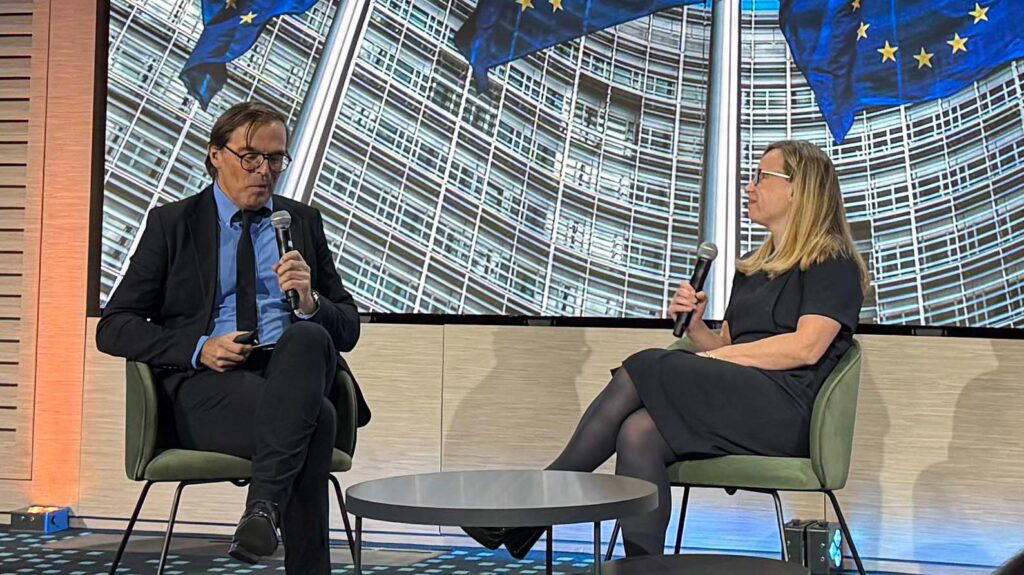
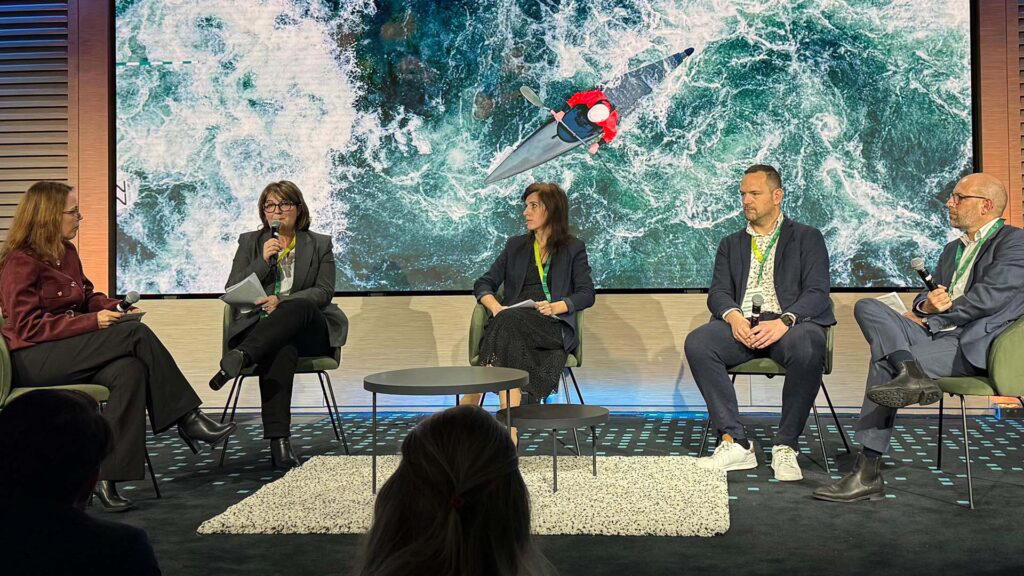
Francois Masquelier and Guylaine Vandooren
Digital assets and the machine economy
Moving swiftly on, the digital currencies and tokenisation segment built on the earlier sessions with a focus on infrastructure. Mellado returned to the stage to set the scene, distinguishing between speculative crypto assets and the regulated instruments – stablecoins, tokenised deposits and future wholesale CBDCs – that are beginning to form the basis of new liquidity and settlement models. His explanation of atomic settlement, where “money leaves your account only because it is already in the account of your creditor,” illustrated the operational and risk-management gains these models can deliver.
An interesting corporate view came from a leading global digital payment, digitisation and financial technology provider who described how one third of the company’s treasury activity now runs on blockchain, processing hundreds of thousands of tokenised transactions to achieve immediate movement of value across borders. “This allows us to have on-demand liquidity that we have been seeking for a long time,” he said, adding that the future of treasury will likely be shaped by the combination of tokenisation and AI.
Taking things to another level, Siemens’ Gherri D’Innocenzo argued that true real-time liquidity challenges the role of traditional forecasting – if cash can be mobilised instantly in response to business events, he suggested, the emphasis shifts from prediction to responsiveness. He then gave an example which brought the concept of responsiveness to life: a robot on a factory floor ordering and paying for its own replacement part on a Sunday night, without waiting for human intervention. “Welcome to the machine economy, where treasury infrastructure must support not just people but autonomous machines initiating and settling their own financial transactions.”
An increasingly colourful skillset
As the day progressed, it became clear that the capabilities required of treasury teams are shifting just as rapidly as the technologies around them. While technical expertise remains foundational, the profession is moving into an era where strategic judgement, technological fluency and cross-functional orchestration are equally powerful.
Current demands require a much broader palette of skills – the ability to think in scenarios, to engage credibly with IT and data teams, to challenge long-held assumptions about liquidity management, and to communicate complex risks in ways that boards and business lines can act upon.
Crucially, the skills profile is becoming more interdisciplinary. Treasury leaders now need a working understanding of AI governance, cyber resilience, operational dependencies, data quality, ISO 20022 structures, API connectivity and digital-asset frameworks, even if they are not experts in each domain. The value lies in being able to connect these threads and translate them into coherent operating models.
This shift was exemplified by Netta Christensen, Head of Global Cash Management, A.P. Moller – Maersk, whose virtual accounts project turned a sprawling landscape of euro accounts across multiple entities and banks into a dramatically simplified structure. The initiative reduced physical accounts by around 90 per cent while improving visibility, liquidity centralisation and control. What made the project successful, she noted, was not technology alone but the ability to navigate tax, legal, regulatory and operational constraints – bringing multiple functions along for the journey and knowing where compromise was necessary in local markets.
It was a powerful reminder that the future treasurer will need to combine architectural thinking with practical execution, often partnering with stakeholders who sit far beyond the traditional treasury perimeter. Treasury transformation is supported by technology but ultimately it is delivered by those people who can orchestrate change end-to-end.
As conversations carried into the evening, the staged cyber incident that had unsettled the room earlier in the day felt increasingly symbolic – treasury’s evolution is not taking place in a controlled laboratory but in environments shaped by disruption, conflicting demands and accelerating expectations.
The day’s refrain – explore the past, define the present, shape the future – served as a reminder of the profession’s expanding mandate. As Fersztand concluded: “The future will not slow down. But for treasurers willing to combine strategic breadth with technological fluency – and a renewed focus on resilience – the future becomes more navigable, even in an era defined by rapid change.”
Architects of the future – event speakers
Isabelle Badoux, Head of Global Treasury Operations, Systems & Treasury Transformation, Sanofi
Lirka Bibezic, Global Head of Product Management for Receivables, BNP Paribas Cash Management
Nicolas Bouvier, Global Head of Sustainability for Transaction Banking, BNP Paribas CIB
Netta Christensen, Head of Global Cash Management, A.P. Moller – Maersk
Kirsty Craig, Regional Treasurer EMEA & APAC, General Mills
Adélaïde Dauneau, Group Treasury Systems Manager and Head of Treasury Operations, Eurofins
Sebastian Daalsgard, Cash Management Advisor, Maersk
Gherri D’Innocenzo, Head of Cash Management & Payments – Standards & Projects, Siemens
Dr Arif Esa, Global Lead for SAP Treasury and Working Capital Solution, SAP
Pierre Fersztand, Global Head of Cash Management, Payments, Trade Solutions & Factoring, BNP Paribas
Bernard Gavgani, Senior Advisor to the Group’s General Management (former Group CIO), BNP Paribas
Wim Grosemans, Global Head of Product Management, Payments & Receivables, BNP Paribas
Yosra Jarraya, CEO, Astran
Yannick Jung, Group Deputy COO, Commercial, Personal Banking & Services