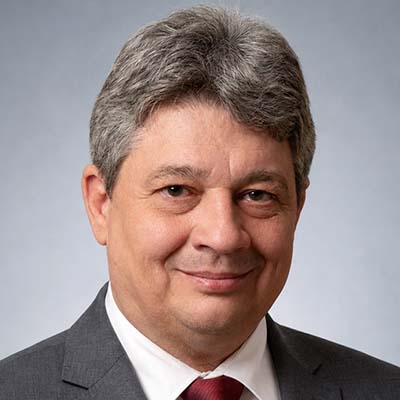
- Tamás Ónody
- President , Hungarian Treasury Club (HTC)
- Tom Alford
- Deputy Editor, Treasury Management International
My Life in Treasury: Tamás Ónody
For some people, stepping into a career and rising up the ranks is only part of the appeal of professional life. They are also driven by a desire to become part of that community, willingly sharing their experience and knowledge, and encouraging growth and progress in all those involved. For Tamás Ónody, President of the Hungarian Treasury Club, that level of professionalism is his way of life.
The notion that treasury is a profession, in the true sense of the word, is always enhanced when its exponents can easily demonstrate how disciplined, highly skilled and indeed specialised they are. Of course, that ‘revelation’ happens every day in the life of the practising treasurer as they keep their organisations financially sound. But from time to time, certain individuals take to the treasury stage bringing a new level of commitment to the role. One such character is Ónody.
An economist, a financial risk management professional, and treasury expert, Ónody has remained dedicated to furthering the cause of the profession for decades. Not only is he the current President of the Hungarian Treasury Club, but he is also a board member of the European Association of Corporate Treasurers (EACT), has been Vice Chairman of the International Group of Treasury Associations (IGTA), and some 15 years ago embarked on building regional co-operation among Central and Eastern European (CEE) treasury associations.
Today, Ónody regularly speaks at conferences on finance and treasury-related topics. And for his work in treasury education, he has been awarded an Honorary Associate Professorship of Finance at Hungary’s Szent István University (see box: ‘Lifelong Learning’).
BOX 1: By the Book
The two-volume book written by Ónody, Europe in Our Wallets – Money Tells the Story, began life in 2010. It was inspired by a week-long family trip to Bulgaria by car. En route, they took in Serbia, Bulgaria, and Romania.
“I had to change money three times, and I noted how each country had designed its notes, admiring their different artwork and security features. Then I started looking at and appreciating the notes everywhere I went, and began collecting them. Friends started to bring me exotic notes, with ever more fantastic designs. But I soon realised that even for neighbouring countries, although I felt I should know who the people were represented on these notes, mostly I didn’t.
I started to explore the details and found that not only were the people interesting, but so too were the other images – the mountains, buildings, flowers, and other emblems – and I started to look deeper into the story of each. It became a passion of mine. I learnt a lot about the different countries, having investigated the life and times of around 250 different notes.
Later, a friend told me that the Hungarian National Bank was creating a foundation for financial culture and suggested I submit my work. Although it was never actually taken up, the book has been printed in its two volumes. Sadly, fewer people these days want such a big coffee-table tome, but more recently I have been thinking about how I could use AI to update it and put the whole thing on the internet, giving people access to contribute to it.”
In his ‘spare time’, Ónody has researched and written a fascinating two-volume study, Europe in Our Wallets – Money Tells the Story, exploring Europe’s historical, cultural, and economic heritage through its banknotes (see box: ‘By the Book’).
It seems like a lot of work for one person, but the core determination of all these activities has remained unchanged for Ónody. It is about maintaining professionalism through the sharing of knowledge and practical experience, and by building professional relationships among treasury’s practitioners and its wider community.
Reflecting on his own immersion in this space, Ónody reveals a commitment that still runs deep to this day. His career, he says, has been shaped by “a fortunate accident” – one that saw him welcomed into a profession “that I came to love”, and a community that has grown from informal conversations “into a lasting institution”.
Changing pace
Ónody began his career in finance at Magyar Hitel Bank, later working for Budapest Bank, and then Crédit Lyonnais Bank Hungary. In 1995, he switched to industry, joining the Eridania Béghin-Say Group, a major European agro-industrial conglomerate, where he eventually became Group Treasurer. By 2000, he moved to Wallis Group where he relished the responsibilities of his position as Treasury Director.
After 23 years at Wallis – “a great career move” – Ónody began to feel it was time for a change of pace and emphasis in his life. Taking early retirement from the demands of full-time employment, he has sought to carve out a role in a professional financial advisory capacity.
This not only affords him the time to engage with his many other interests beyond treasury, not least his passion for music, but has also seen him broadening the scope of his work beyond pure treasury.
Feeling that over his career he has seen the rise of an ever-more professional approach to corporate treasury, Ónody believes now that generally “it’s not an area where I can add much”. It’s not true of course, but not long into his retirement, with plans for other activities barely formed, he was approached by friends and former colleagues who were stepping up as entrepreneurs and seeking his advice. Today, he has four financial advisory projects on the go.
Ónody now finds himself, again almost by accident, helping his clients research and build financial packages for presentation to banks or investors, essentially “translating their needs into a language and format that financial people understand”.
It’s a language to which he is, of course, well attuned. But exposure to the work of entrepreneurs is not an entirely new experience for him either. In both Wallis and Eridania Béghin-Say Group, a policy was adopted of researching upcoming companies, new ideas, and fresh approaches, to see what could be incorporated. Often it was the M&A team taking the lead here, but as “the financial guy”, Ónody explains that he would always “take a look”, familiarising himself with each business prospect and advising colleagues accordingly.
Within Eridania Béghin-Say in particular, with its largely predictable seasonal flows, this extra-curricular advisory work became a welcome addition for Ónody. Today, he enjoys the same excitement at the unpredictability of what’s coming his way with his small, select group of clients covering a diverse spread of sectors and needs.
Indeed, though he has remained in some of his roles for many years, this has never hindered Ónody’s pursuit of new avenues. “There was a moment in my life, when I reached 61, that I thought it was time to stop going to the office every day and start planning a new agenda,” he reveals. “And now, what I’m doing again is establishing a new way of balancing life and work, finding one that gives me more time for myself, my family, and my hobbies.”
BOX 2: Lifelong Learning
As a mark of the respect with which Ónody is accorded in Hungarian treasury society, he was appointed Honorary Associate Professor of Finance at Szent István University in 2013. He naturally regards this as an important professional recognition. “Since treasury at that time was still a developing discipline in Hungary, I considered it important to share practical experience and help make the function better understood among students, financial professionals, and business leaders,” he explains.
Alongside other Treasury Club members, in addition to sitting on exam boards, Ónody also delivered lectures, sometimes to an auditorium of up to 400 students. “Together with university finance department academics, we developed a series of lectures that brought outside experts to regular teaching. Because treasury was not yet an established subject in university education, it was a way of explaining how treasury works in real life.”
Planning for a roller-coaster ride
Of course, the world of treasury still holds a fascination for Ónody. He aims to continue his Treasury Club activities, organising events and conferences to help maintain its professional outlook long into the future. As he notes, there will always be new aspects to learn and new crises to tackle together.
Following relative financial stability after the 2008 financial crisis, Ónody recalls a period where the treasury world “came back to normal life, financing was fine, and interest was low”. And then came the outbreak and fallout from Covid-19 in 2020.
“I remember the last meeting of Treasury Club in 2019. We talked about what we expected from 2020. Everybody was discussing the impact of Brexit and so on, but now all that seems so far away because suddenly, boom, Covid happened. Then it was the war in Ukraine. And now we are in the midst of new uncertainty with the impact of President Trump’s actions around the world, and the recent political change in Hungary.”
Of course, Ónody understands that this almost constant economic and geopolitical roller-coaster ride impacts the way companies and their treasurers approach planning. “For the best part of 20 years, the Hungarian forint always decreased in value each year by 2-3% . For exporters, it meant a little extra profit. And although the opposite was true for importers, it acted as a base expectation for all,” he comments.
Following the April 2026 election in Hungary, the forint strengthened sharply to a four-year high against the euro and a multi-year high against the US dollar. “It makes the currency look stronger but exporters and importers are looking at its rise like some kind of black swan event. In today’s world, we should always expect something dramatic to come along, and it may even be positive.”
Events have certainly shaped how the Treasury Club of Hungary operates and has structured itself for its membership. It was formed the early 1990s “by chance” to cater to a growing number of finance professionals working in both domestic and international settings and looking to drive improvements in liquidity management and financing.
“The financial community in Budapest is quite close, so we started to get together monthly for discussions. It was really useful because we could exchange ideas and thoughts, and we called on each other, just sharing experiences and knowledge,” explains Ónody. “It really was an informal club at first, but it worked so well that we decided to create an official association. It still has that original ‘hub of experience’ feel today.”
The constant treasurer
For Ónody, the appeal of treasury has never diminished. Part of what drives him to continue his involvement is the sense of responsibility that comes with the territory. It struck him early on in his career that there are functions in a company that, through their endeavours, can be clearly seen to generate income – production and sales for instance.
“But the treasurer, through their good or bad decisions, can in an instant protect or dissolve a large part of what has been generated by the efforts of so many colleagues. That places a huge responsibility on treasury to safeguard the value of the business,” states Ónody. “Of course, the numbers can be enormous, so treasury really has to take care of what it is doing, and understand what others around them are doing, to know how to control the flows in an optimal way.”
The treasury profession has learnt to deal with its responsibilities with composure, but sometimes even the best will feel the pressure, Ónody admits. When in the peak of the 2008 financial crisis many banks dramatically reduced or even stopped credit lines to corporate clients, the spotlight shifted to the world’s treasurers and finance functions to find a way forward, and many felt its intensity like never before.
It’s in rare moments such as this that treasury professionalism comes into sharp relief for all. However, Ónody believes treasurers are generally accorded respect for what they regularly achieve by those that come into contact with the function, and he notes that treasury voices are heard.
When Ónody switched his position at the multinational Eridania Béghin-Say Group for the ambitiously expanding Wallis Group, his treasury experience was called upon to help establish and maintain a robust financial framework. “I felt that the business understood what I was saying about how the huge amounts of money flowing through the system had to be firmly controlled,” he explains.
Don’t panic, keep up!
Over the years, Ónody has perfected his approach to treasury. One of the key skills he cites across his tenure is that of remaining calm under pressure. “It’s not always easy to do, but staying calm, stepping back a little and seeing what others are doing and saying, and trying to understand all sides of a situation is vital,” he offers. Another skill he has developed, as the one usually in discussion with the banks, is that of diplomacy. “I’ve always tried to be an ambassador for my company.”
Alongside these important personal traits, Ónody believes it is increasingly central to the treasurer’s success to remain abreast of technological developments. While an interest in new tools has always been part of his approach (as far back as the emergence of Excel), he feels that the current acceleration of digitisation in treasury demands rather more active oversight.
“I’m a big fan of AI,” he states. For his own use he has been following training sessions, and for the time being uses it as an assistant, revealing that “every day I find something new for my own use”. In treasury though, he feels AI is yet to make a proper impact. “I’ve been talking about this a lot. There are some good ideas coming through, but I’m yet to see an AI solution that is acceptable for every company. It’s not yet managing FX risk, and while they say it exists in cash management, I’m not seeing it. But it will come. And this is why treasurers need to explore and understand how it works now.”
International networks
Having moved on in his own career, towards a retirement of sorts, Ónody says that he will most miss the international interactions of daily corporate treasury life. However, he feels fortunate in that he retains a strong connection with the EACT and its international community.
He also remains very much involved in bringing together treasurers and experts from associated fields from Central and Eastern Europe (CEE), helping to run an annual event that serves as complementary to EACT’s own annual Summit in Brussels. “I’m very proud of this because when we started in 2012, we were on our own. It was a huge organisational task for non-professional organisers like us. And then fortunately TMI arrived and it’s become so much easier now!”
Ónody is also justifiably proud of his work in not just bringing the Treasury Club into being, but also in ensuring it has been going from strength to strength over the past three decades. “A friend told me that if it’s still running after 30 years, then it must be good. But I feel maybe now would be a good time for me to hand it over to some younger guys. There are plenty of good people who could take it on, but the problem is who now has the time to do it justice?”
Patience is a virtue
While this may be the moment for up-and-coming professionals to ponder how they might take the Treasury Club, and indeed the role of treasurer, forward, Ónody is already plotting how he will fill his time between financial advisory work with “more music, family, and friends”.
But he has a message for all newcomers to the profession: “Resist the urge to change the world immediately.” He explains: “I know they are looking at how crazy this system is, or what a mess that one is, and most of the time they are right. But often young people are a little too quick to make decisions. In treasury, even if you are a genius, you really don’t have to change the world straightaway. Be patient. Think about what you could do, work on your plan, and then slowly make those changes. That way, the foundations you build will be so much more solid.”
The considered approach is perhaps the foundation of a career that has delivered so much for Ónody, and indeed for those that have worked alongside him. But by his own admission he feels “fortunate” to have worked in environments where these professional considerations have always remained at the centre of his work.
“I’ve been able to maintain an independent and neutral position without having to make professional compromises, and without seeking or receiving any particular advantage from such considerations,” he comments. “And looking back, I see this as a valuable part of my professional journey.” And professionalism, ultimately, is what successful treasury is all about.