
- Eleanor Hill
- Editorial Consultant, Treasury Management International (TMI)
The Irish Association of Corporate Treasurers’ (IACT) Annual Treasury Management Conference, held at The Convention Centre Dublin in November 2025, focused on funding, FX, payments, technology, liquidity, and soft skills – outlining how treasury safety nets are being reinforced for the year ahead.
Treasurers are not in the business of baseless prediction. They are in the business of preparation. And this distinction shaped the tone of this year’s IACT Annual Treasury Conference, where discussion focused less on what the next shock or trend might be, and more on how well existing structures, frameworks, and decision-making processes would stand up, or evolve, when tested.
The day’s agenda ranged widely – from sovereign debt and FX volatility to payments transformation, AI and cyber risk – yet a common concern ran through the day: how treasury safety nets are being re-examined, reinforced and, in some cases, re-engineered for an environment that no longer behaves in predictable cycles.
Rather than searching for new certainties, speakers returned repeatedly to fundamentals: liquidity, optionality, governance, and judgement. The message was not that treasurers are operating without protection, but that the nature of those protections is evolving as the macro context becomes more complex and interconnected, as well as less forgiving of weak links.
Operating closer to the centre
In his opening remarks, Jason Murphy, outgoing President of the IACT, and Co-Founder and Executive Director, Centrus, reflected on how treasury’s position within organisations has shifted in recent years, as funding, liquidity, risk, technology, and data concerns have converged. Treasury is now expected to interpret external volatility and translate it into decisions that the business can act upon, often under time pressure and with incomplete information.
That proximity brings both influence and responsibility. Treasury teams remain accountable for the basics – ensuring payments are made, liquidity is available, and risks are controlled – while also contributing to strategic conversations around technology adoption, resilience, and capital allocation. As several speakers acknowledged throughout the day, the challenge here lies in balancing those demands without weakening execution or overstretching already lean teams. As Murphy noted, treasury now sits “right at the centre of business-critical decisions”, expected to combine technical rigour with strategic judgment.
Adaptability built into structure
The notion of balance was further explored from a sovereign perspective by Dave McEvoy, Director of Funding & Debt Management, the National Treasury Management Agency (NTMA), whose keynote examined adaptability as a structural discipline rather than a reactive stance.
McEvoy described how Ireland’s funding strategy is designed to preserve choice across a range of potential futures, using a combination of maturity management, asset buffers, and measured market engagement to avoid being forced into unfavourable decisions. Rather than optimising around a single forecast, the emphasis is on maintaining flexibility and ensuring that levers remain available when conditions change. “The objective is to make sure you still have options,” he observed, stressing that resilience is embedded long before it is tested.
For corporate treasurers, the parallels were clear. While balance sheets differ in scale and complexity, the underlying principle is familiar – prepare ahead through conservative assumptions, diversified funding sources, and governance frameworks that enable decisions to be made deliberately rather than defensively. Adaptability, in this sense, is less about speed (although it is a factor) and more about ensuring that responses remain proportionate and controlled.
Payments transformation takes hold
A morning panel session on payments and treasury transformation grounded these ideas firmly in the day-to-day corporate experience. Julia Donegan, Global Treasury Director, Newell Brands, and Colm Lawlor, Director of Treasury, Ingersoll Rand, spoke about operating in organisations shaped by acquisition, where banking structures and processes had grown unevenly over time. In both cases, treasury teams were managing significant complexity not because it was strategically desirable, but because it had accumulated incrementally and had never been fully addressed.
During lively discussions on stage, they highlighted how transformation often begins with stabilisation – improving visibility, rationalising bank accounts, and removing manual processes that introduce risk and inefficiency. Lawlor emphasised the importance of reducing friction for operational teams, noting that complexity does not simply slow execution, but undermines confidence in change initiatives themselves. “If the basics don’t work,” he suggested, “it’s very hard to get people to believe in the bigger picture.”
Stew Cofer, Executive Director and EMEA Head of Payment Specialists, Commercialisation & Embedded Solutions, J.P. Morgan, added an important framing by distinguishing between the motivations behind treasury transformation. Some initiatives are driven by strategic curiosity, others by rapid growth, and others by mandate, when existing structures no longer work.
Recognising which force is at play, he argued, is critical to setting realistic expectations and designing solutions that deliver tangible value rather than incremental frustration.
Meanwhile, John Murray, Ireland Head of Subsidiary Payments Sales, J.P. Morgan, reinforced the need to align ambition with operational readiness in order to make the most of the payments opportunities on offer.
A reflective counterpoint to this discussion came from Professor Brian O’Kelly, Emeritus Professor of Finance, Dublin City University, whose presentation, Plus ça change, plus c’est la même chose, challenged the audience to look beyond the surface of today’s transformation narratives. While tools, data, and market structures continue to evolve, he argued, many of treasury’s core tensions – between risk and return, control and flexibility, centralisation and local reality – remain stubbornly familiar. The session served as a timely reminder that innovation does not eliminate judgment, and that experience still matters when old problems reappear in new forms.
The value of FX discipline
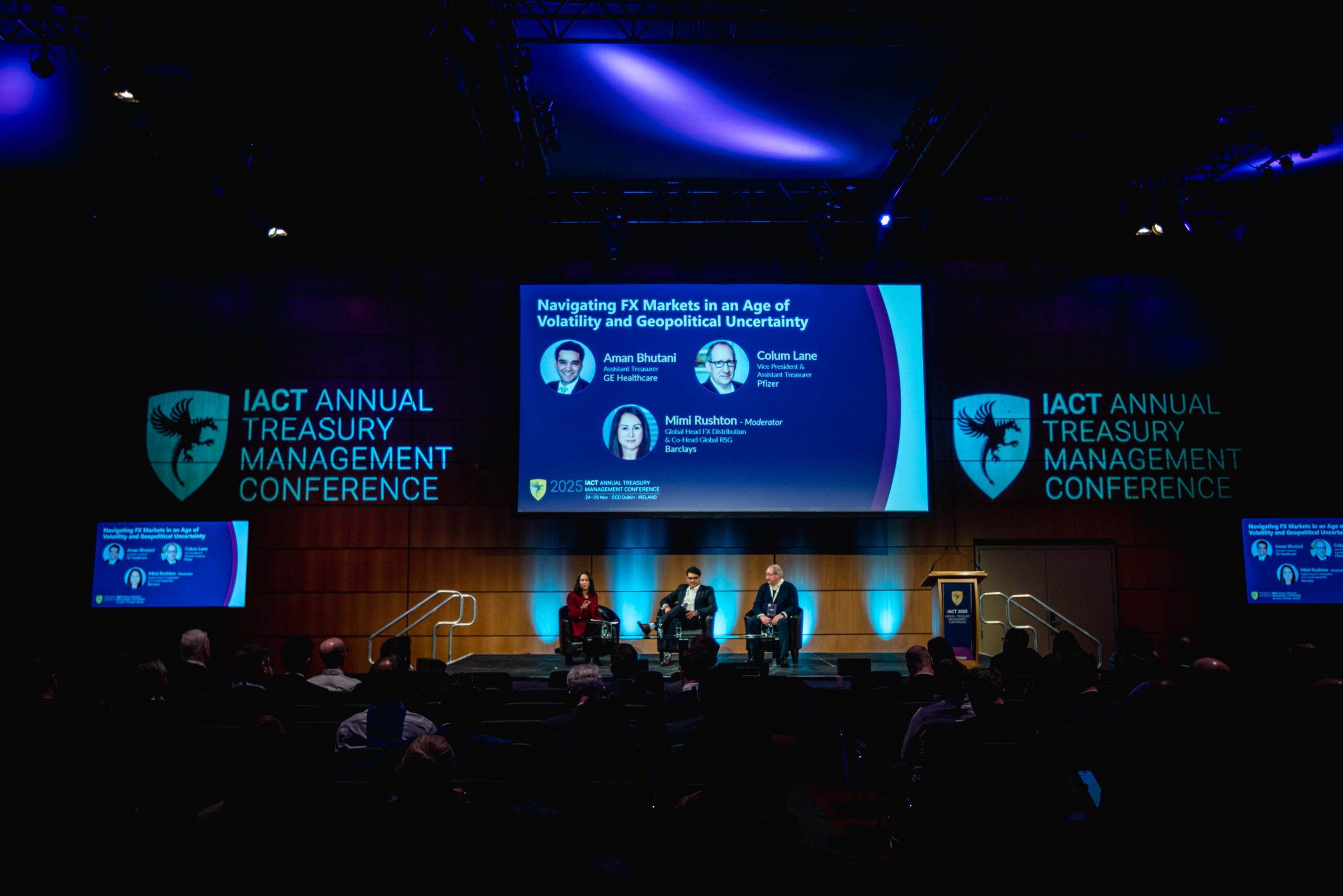
A similar maturity of perspective came across in the following panel, moderated by Mimi Rushton, Global Head of FX Distribution and Co-Head of Global RSG, Barclays. The discussion acknowledged a year marked by sharp currency movements and geopolitical tension, while also challenging the assumption that volatility automatically demands action.
Colum Lane, Vice President and Assistant Treasurer, Pfizer, and Aman Bhutani, Assistant Treasurer, GE Healthcare, both returned to the importance of structural drivers – interest rate differentials, growth outlooks, and risk sentiment – as the primary forces shaping FX markets over time.
Their remarks reinforced the role of well-designed hedging frameworks as stabilising mechanisms, enabling treasurers to absorb short-term shocks without continually recalibrating strategy. In volatile conditions, judgment often lies in distinguishing between developments that warrant response and those that are better accommodated within existing risk tolerances. As one panellist noted, discipline is often expressed in restraint rather than activity.
When transformation becomes forensic
Next up, the 2024 IACT award-winning case study from Viatris provided a detailed view of what rebuilding treasury foundations can look like in practice. Keith Lynch, Senior Director at the pharma company, described the task of establishing a global treasury centre of excellence following a major merger, encompassing hundreds of legal entities, a vast bank account footprint and multiple banking relationships. Progress depended not on rapid innovation but on painstaking work to establish accurate records, clear authorities, and reliable visibility over cash and accounts.
The emphasis on creating a single source of truth resonated strongly with the audience, and the broader themes of the day. Without it, optimisation efforts remain surface-level. But with it, treasury teams can make decisions with confidence and improved consistency. Lynch’s lively recounting of the project also underscored how resilience at scale is built through persistence, governance, and attention to detail rather than performative or dramatic transformation.
Exploring the limits of technology and intelligence
Afternoon breakout sessions expanded the discussion to technology-led change, particularly around AI, cyber risk and fraud prevention, as well as the soft skills needed to stay resilient.
The extremely popular AI session focused on practical application, highlighting areas such as cash forecasting and anomaly detection where ML is already delivering measurable benefit. Speakers stressed that success depends on disciplined data management and clear problem definition, and that governance remains essential to ensure that intelligence supports, rather than supplants, human judgment. As one speaker cautioned, the risk is not that AI gets things wrong, but that it is trusted too quickly.
Cyber and fraud discussions reflected an environment where faster payments and richer data flows leave less room for error. Verification processes, behavioural analysis, and end-to-end visibility are increasingly central to treasury control frameworks, particularly as threat vectors grow more sophisticated.
Alongside the technology-led sessions, a breakout on grit and resilience, led by Teresa Kelleher, Head of Group Treasury, Musgrave, explored the human dimension of operating in times of sustained uncertainty, drawing a clear distinction between organisational resilience built through structure and individual grit developed under pressure. The discussion struck a chord by focusing on how communication and decision quality can be affected when volatility becomes the norm rather than the exception.
Elsewhere, a breakout on trade tariffs led by S&P Global Ratings’ Nikolay Popov, Director, and Manish Kejriwal, Associate Director, examined how tariff regimes feed into credit analysis, not as one-off shocks but as structural inputs affecting cash flow resilience, cost pass-through and long-term competitiveness. The session provided a useful reminder that ratings impact often emerges gradually, shaped as much by management response and financial policy as by the tariff itself.
Finally, the IACT Live session offered a rapid series of case studies from corporates shortlisted for the 2025 IACT Award, featuring: Catherine O’Donnell, Treasury Manager, AIG; Wiebke Foerstmann, Treasurer, BASF Ireland DAC; Steven Ellis, Treasury Manager, Flutter Entertainment; and Tomas Kozanek, Treasury Director, Solventum. In a packed room, the session highlighted how treasury teams are dealing with complexity in real-time – balancing control, adaptability, and delivery without the luxury of perfect conditions.
As it turned out, all four companies went on to win an IACT Award, recognising just how strong the innovation DNA is within the Irish treasury community.
Liquidity structures and realistic trade-offs
Concluding the day’s panel discussions, a session on multicurrency notional pooling brought the conversation back to liquidity, while resisting the temptation to oversimplify.
Aoife McGuirk, Manager of Treasury Operations, Meta; Paul Fannon, International Treasury Manager, Equifax; and Hannah Boaden, Managing Director and Head of EMEA Liquidity Product, Global Payment Solutions, Bank of America, discussed the benefits of pooling structures alongside the constraints imposed by legal, tax, and regulatory considerations. Successful implementations were characterised by clear governance, early alignment with stakeholders, and an acceptance that centralisation is rarely absolute. Liquidity optimisation, as the discussion made clear, is shaped as much by organisational realities as by product capability.
Lessons for 2026 and beyond
Throughout the day, Matt Cooper, broadcaster, podcaster and journalist, played a central role in shaping the conversation as conference chair, keeping discussions grounded, focused and accessible without diluting their substance. In his closing remarks, he returned to the practical realities facing treasurers, drawing together themes of uncertainty, judgment and responsibility, and reminding the room that while markets, technology, and geopolitics may remain unpredictable, the role of treasury in providing stability and perspective within organisations has rarely been more critical.
Taken together, the day’s discussions suggested a profession focused less on reinforcement and more on strengthening safety nets, clarifying decisions, and ensuring that systems, processes and people are aligned to cope with continued uncertainty.
Treasurers are all too aware that resilience depends not only on having structures in place but on understanding how those structures behave under pressure. The conversations at the IACT Annual Treasury Conference reflected a determination to ensure that treasury remains a stabilising force – but also an innovative one – as the environment continues to evolve.