
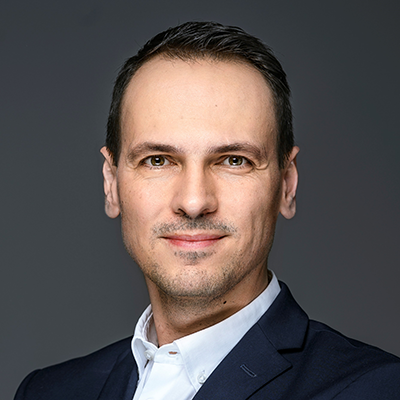
- Gábor Dávid Szűcs
- Director of Financial Operations, Gedeon Richter

- Jorg Konrath
- Head of Cash Management, Central Europe, BNP Paribas

- Krisztina Molnár
- Head of Cash Management, Hungary, BNP Paribas
Gedeon Richter’s Formula for Cash Control
By pooling cash across 12 Western European countries, Gedeon Richter has centralised half its liquidity. This has sharpened governance, lowered costs, and created a platform for regional and digital ambitions.
When pharmaceutical company Gedeon Richter set out to transform its treasury from its headquarters in Hungary, the ambition was clear: centralise liquidity, cut costs, and reduce the drag of idle cash scattered across subsidiaries. But the execution demanded something more elusive, a structure that could simplify processes without destabilising the business.
The cornerstone to the transformation was a euro cash-pooling project, built to improve cash visibility, optimise interest, and bring consistency to banking connections. In practice, it meant pulling together 12 Western European countries under one umbrella in a phased approach, harmonising processes to improve liquidity management efficiency.
Gábor Dávid Szűcs, Director of Financial Operations, Gedeon Richter, explains: “We identified the most relevant countries first from a cash flow and turnover perspective.” Six subsidiaries formed the starting point, followed by an expansion until the pool stretched across a dozen jurisdictions.
The phased approach was vital. Each wave had to be delivered within just a few months, and treasury could not risk a big-bang roll-out only to discover later that local constraints had been overlooked.
What emerged was more than a liquidity structure. The pooling exercise forced the company to confront questions of governance, intercompany funding, and its approach towards cash management.
Governance gains
One of the most striking outcomes of the new pooling structure was governance. It created a unified platform, giving the headquarters complete visibility and control over access rights. Administrator privileges, once dispersed across local entities, were controlled from HQ in Budapest.
“Everything from daily balances, cash movements, interest allocation, and transfer pricing is controlled centrally from the group level,” Szűcs says with pride. “This is a milestone for us.”
The benefits went beyond oversight. Intercompany limits could be defined clearly, giving subsidiaries access to liquidity without blurring the line between cash pooling and long-term funding, with the former becoming a flexible short-term mechanism.
BNP Paribas, as banking partner, played a role here too. The bank’s systems allowed central monitoring while accommodating local compliance rules. That balance between centralisation and flexibility was critical to achieve broad-based support across jurisdictions.
Operational backbone
If governance provided the framework, operations supplied the muscle. Building a multicountry pool meant overcoming two familiar challenges: documentation and deadlines. KYC checks and legal due diligence became particularly demanding as phase two brought more entities into scope.
Krisztina Molnár, Head of Cash Management, Hungary, BNP Paribas, elaborates: “The short timeline was the main challenge. That’s why we created a dedicated project team for Gedeon Richter, with a senior project manager and weekly calls to keep momentum. The commitment of both sides made the difference.”
Establishing the proper intraday limits was critical. Without correctly set thresholds, payments risked being delayed, with manual workarounds undermining efficiency. “The intraday limit should cover supplier payments and payroll, not exceptional one-off items,” notes Molnar. “That’s what ensures smooth operations.”
The approach to country selection also reflected this pragmatism. The initial six held the bulk of euro liquidity and turnover, delivering immediate impact without overcomplicating implementation. By the time the structure covered 12 jurisdictions, the operational model was robust enough to scale without adding risk.
The support from BNP Paribas did not stop at the go-live of the cash pool. “Across so many countries, there are always different daily needs,” Molnár points out. “Our role is to be responsive and make sure issues are addressed quickly.” Sustaining service levels has become as essential as the project design itself.
Expanding the pool
The reward for that rigour is clear: close to 50% of global cash and the majority of euro balances are now centralised. That delivers an anticipated level of control and efficiency. But treasury sees this as a midpoint rather than a finish line.
“We are pleased with the number, but we are going further,” Szűcs reveals. The next phase involves reviewing invoicing practices within the group and exploring possibilities to extend the structure to other currencies and countries. Jurisdictions with FX controls present particular challenges, requiring tailored approaches. Western Europe offered the ideal conditions for a euro pool, though repeating the model in other regions will bring greater challenges.
Jörg Konrath, Head of Cash Management, Central Europe, BNP Paribas, underlines the point. “Fifty per cent is already a great achievement. The next steps for corporates are usually regional pools in North America, Asia and the Gulf. Each region brings its own rules. In Asia, Singapore and Hong Kong are straightforward, while China is highly restrictive. And corporate treasurers look increasingly for alternative solutions such as POBO and COBO and explore tools like virtual accounts to bring funds under centralised oversight.”
Gedeon Richter’s priority is to keep evaluating how cash is channelled and where regional sub-pools make sense. The journey is ongoing, and each jurisdiction will demand its own solution.
Building on electronic banking platform
Gedeon Richter leveraged BNP Paribas’ Connexis electronic banking platform extensively, which supported reporting, liquidity, and concentration tools across the participating countries.
“Connexis supports not just the standard but also most local payment types, and it includes cash concentration and intercompany modules,” highlights Molnár. That breadth was essential for a multijurisdiction pool, ensuring consistent visibility even where payment formats varied.
The platform has proved to be more than a stopgap. “Electronic banking has been beneficial for payments, reporting, and liquidity management,” Szűcs enthuses. “Having a single centralised platform gives us visibility and automation which would have been less efficient with multiple bank systems.” What began as a technical enabler of pooling turned into a positive side effect: a fit-for-purpose interim tool that improved visibility group-wide.
Those gains come as larger technology projects advance. The company is implementing SAP S/4HANA as its ERP, with an advanced treasury module, alongside the selection of a dedicated TMS to automate workflows and enhance decision-making. But such initiatives take time.
“Implementing S/4HANA and a TMS is an extended process,” reflects Szűcs. “The pool gave us a workable solution in the meantime, supporting clear visibility while bigger projects were underway.”
Priorities beyond liquidity
Centralising liquidity is only one element of this treasury’s agenda. Managing volatility across currencies, commodities, and energy markets is just as critical. Gedeon Richter applies a forward-hedging strategy for key exposures, layering positions several quarters ahead to stabilise revenues.
“Beyond FX exposure, we also look at commodities such as natural gas, electricity, and steam. We want to eliminate volatility wherever possible,” explains Szűcs.
That risk discipline extends into sustainability. In July 2025, Gedeon Richter signed a three-year power purchase agreement covering around half of its Hungarian electricity needs. “It enables hedging by removing volatility, it’s good for planning, and it’s good for ESG,” Szűcs enthuses. The initiative illustrates how treasury can contribute directly to corporate sustainability targets while also strengthening financial resilience.
It is part of BNP Paribas’ core strategy to support corporates on their way to carbon neutrality. “In 2021, we were one of the first banks to join the Net-Zero Banking Alliance launched by the United Nations,” Konrath points out. “We have a low-carbon transition group with more than 250 bankers, offering expertise across ESG solutions. We want to grow with our clients, hand in hand.”
Sustainability and risk management are not separate agendas. Treasury’s hedging strategies and the company’s ESG commitments reinforce one another, creating both stability and impact.
Culture and change
The cultural shift was just as significant as treasury’s technical impact on this project. Implementing the pool required alignment across finance, legal, tax, and even energy teams. Without that collaboration, the project would have faltered.
“This was a typical cross-functional initiative,” recalls Szűcs. “It could not have been delivered without the support of other business functions. At the beginning, we aligned key stakeholders about the objectives, why their involvement was essential, and why their support was the precondition for success.”
Workshops and a steering committee provided the forum, while BNP Paribas’ experience across similar projects offered reassurance. Over time, subsidiaries recognised that the pool optimised not only group liquidity but also their own banking platforms, interest revenue, and IT solutions.
Konrath frames it succinctly: “It’s not only about technology, it’s about people. Alignment, education, and shifting behaviour are what make a project succeed, not only during implementation but afterwards too.”
Measuring success
Treasury has turned the pool’s objectives into a set of KPIs that track progress and guide decision-making. “As the saying goes, what gets measured gets managed,” Szűcs acknowledges.
Cash visibility, interest gains versus benchmark, participation rates, and concentration levels all form part of the dashboard. Crucially, the metrics apply at the group and subsidiary level, meaning local teams also have a clear view of benefits.
These metrics evolve as the structure matures. While early focus was visibility; attention is now shifting to participation and concentration. “Those KPIs are essentially a translation of our objectives,” says Szűcs. The framework provides evidence, accountability, and a language that resonates throughout the business.
That language has proved valuable for change management. Hard numbers helped convince local teams that pooling was not just a theoretical construct but a tangible source of efficiency and savings. By turning strategy into metrics, treasury gave stakeholders a way to see progress in real time, bringing to life a subtle but powerful tool in shifting culture as well as cash.
Discipline and partnership
Cash pooling may be a staple of liquidity management, but execution is rarely effortless. “The concept is simple, the benefits are clear, but the execution needs planning and special expertise,” advises Szűcs.
The phased roll-out is one example of this attention to detail. The project also underlined that success is measured as much after go-live as during implementation. For the bank, that means day-to-day responsiveness. “Maintaining service levels is just as crucial as the project implementation itself,” asserts Molnár. “Daily support across so many countries requires sustained energy, not just an initial push.”
For treasury, the bigger picture is partnership. “This is like a marriage,” reflects Szűcs. “Go-live is not the end, but the beginning. You need to create value every day, working with your banking partner to keep pace as business needs evolve. Limits change, preferences change, and treasury has to respond.”
Towards creating ‘extraordinary value’
The euro cash pool has given Gedeon Richter a platform for cash visibility and control, centralising half of its global liquidity and most of its euro balances. It has sharpened governance, reduced costs, and created a cultural shift that places treasury at the heart of decision-making.
Potential next steps include extending the structures, advancing technology roll-outs and the ongoing integration of ESG objectives. As structures grow more complex, so, too, does the scope for treasury to create value. That clarity of purpose gives treasury momentum for the next stage of transformation.
“A cash pool is a straightforward concept and the benefits are obvious,” concludes Szűcs. “The real challenge is not in aligning stakeholders, but in how you implement it. With structured planning, even a straightforward design can deliver extraordinary value.”