
- Ben Poole
- Editorial Team, Treasury Management International (TMI)
by Ben Poole, Ben Poole Editorial Services
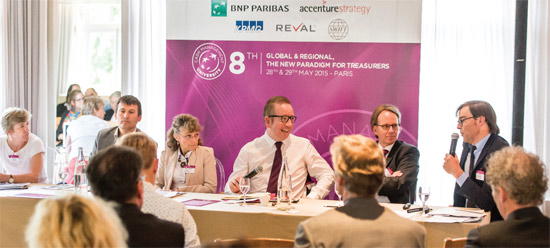
The quest for end-to-end cash visibility is critical for today’s treasurer. However, without a full view of all bank accounts being used by the organisation, this is always going to be nearly impossible to achieve. Because of this, bank account management has never been more critical for corporates. A workshop on day two of the 8th BNP Paribas Cash Management University explored this topic, with perspectives from treasurers, bankers and third parties.
The current landscape
Carsten Jäkel, Partner Finance & Treasury Management with KPMG, opened the workshop by reporting some interesting results from a recent survey on bank account management carried out by the firm. Three-quarters (75%) of the survey respondents have a revenue of €1bn or more per year.
A key finding of the survey is that the treasury landscape is quite scattered. Some 42% of respondents have an in-house bank (IHB) or payment factory established. Twenty-nine per cent have either partly implemented, initiated or plan to initiate this kind of project, while the remaining 29% don’t have anything like this in place. The variety of banks used for payment execution also differs. At the lower end, 37% use between one and five banks and 21.7% use between six and ten banks. At the same time, 19.6% of treasurers are using 11-20 banks for payment execution, while a not-insubstantial 17.4% use over 20 banks. The survey results also highlighted that a large majority of treasurers (over 90%) recognise the need to reduce the number of bank accounts that they hold around the world.
Jäkel’s presentation described how the survey uncovered a possible contradiction in the approach that corporates have towards internal controls and fraud. When it comes to evaluating the processes they have in place to prevent black money transfers, a majority of treasurers (61%) say that their prevention methods are good or very good. However, the survey also found that 80% of treasurers do not have a central tool to run their bank account management, while only 12% say that they have an adequate tool for this purpose. A central bank account management tool is vital to have full visibility over all subsidiary bank accounts around the world. Ninety-three per cent of treasurers surveyed say that this single source of truth is the main benefit that they see from a bank account management tool.
Corporate perspectives
Patrick Pots from Statoil outlined the company’s approach to bank account management. The scale of the company’s operations means that the Statoil treasury needs to keep close control of its bank account management processes. The company has a presence in 36 countries and has around 220 business entities around the globe. The company has relationships with around 50 banks, 20 of these being part of the core banking group, of which four are the company’s main banks. All in all, Pots said that the company manages around 836 bank accounts.
The eBAM model that Statoil uses manages the internal account opening and approval processes, follow up status messages and bank account reporting. Pots said that his treasury has realised several benefits of proactive bank account management, citing the control that a centralised process allows. The company has a service level agreement with its main banks, and also has a central account database in its enterprise resource planning (ERP) system. Pots said that the process towards the banks is still manual and the company is further analysing what can be achieved through eBAM and other bank account management software.
Despite the benefits of active bank account management, Pots said that there are still some pain points that need to be addressed. He said that first and foremost it is a very time-consuming exercise, which can have an impact on the running of the business. In addition, Pots said that a simple digital standard is required to improve issues around know your customer (KYC) and documentation challenges, bank communications and mandate management.
François Masquelier, Head of Corporate Finance, Treasury and ERM at RTL Group, agreed that bank account management is time-consuming. He pointed to regulations such as MiFID, EMIR and various KYC and anti-money laundering (AML) requirements which add further complications to the process, taking even more of the treasurer’s time. Furthermore, Masquelier added that banks are going about eBAM at different paces, and that this lack of a multi-bank approach is frustrating for corporates, who are faced with a lack of harmonisation of eBAM message types.
KYC requirements present another challenge for corporates running a bank account management programme. The forms that treasurers have to fill out to meet these requirements have become increasingly complex and take valuable time away from managing other treasury processes. Masquelier suggested that a global KYC register could be a solution to this issue. Similar to the SWIFT register that banks use, this could provide a central secure source of information available to all banking counterparties. When the workshop audience were asked for a show of hands as to who would be interested in participating in this kind of central registry, a large number were in favour.
Masquelier outlined the following drivers as to why corporates may be looking to implement an eBAM tool:
- It creates a central repository for all bank account documentations and contracts (this requires adapted interfaced IT tools).
- eBAM controls work flows and defines automated processes for bank account maintenance.
- It ensures an electronic, formatted exchange of information between banks and customers.
- Paperless process significantly reduces costs and operational risks.
- An eBAM project can be seen as the final stage of an in-house bank and a single bank gateway project.
- eBAM provides a comprehensive uniform reporting system on bank relationships. This allows treasurers to gain better control over group accounts and actively manage them.
- The external audit review process is enhanced.
- It allows for a better management of proxies and power of signature.
[[[PAGE]]]
Despite these benefits, referring back to an earlier point, Masquelier said that the lack of harmonisation on the banking side could mean that it is too early for corporates to benefit from the full potential of eBAM. He added that an eBAM project might also be a tough thing for treasurers to sell to senior management at the current time, as aside from the qualitative benefits it can be hard to demonstrate the added value of such a project.
While challenges for eBAM remain, the potential benefits it offers are tantalising. Masquelier noted that eBAM could be considered to be the ultimate stage of a fully centralised treasury organisation, enhancing treasury’s internal controls and optimising corporate bank relationships. He concluded by suggesting that, once eBAM is set up, it could become a key criterion in corporates’ selection of any new bank partners.
Bank initiatives
An update of the BNP Paribas eBAM initiatives was provided by Marie-Laurence Faure, Head of Marketing Channels, and Florence Meunier, Head of Bank Partnership and International Desk with BNP Paribas Cash Management. The bank offers three eBAM solutions, covering account opening and mandate management processes, with different solutions positioned for different corporates depending on their size or requirements.
The online MyAccounts tool is designed to assist corporates in the account opening process. It aims to harmonise all account opening request forms and signature cards, allowing corporates to request account openings, designate authorised signatories, assess and accept contractual documentation and provide access to the documents and supporting evidence required for account opening.
The other solutions - Connexis eBAM and eBAM File Transfer - focus on the mandate management side of the process, with account opening functionality to be added in the future. Faure and Meunier outlined the target for these initiatives, which is for them all to offer both account opening and mandate management. MyAccounts is to be positioned as an option for corporates of all sizes. In contrast, Connexis eBAM is positioned for large or mid-range corporates, while eBAM File Transfer is viewed as the preferred tool for large corporates.
While this workshop showed that there is work to be done in the banking space to develop the perfect conditions for eBAM, it also demonstrated that progress is being made. The potential benefits of eBAM are clear for corporates to see and, while they may not all be attainable today, the promise of greater controls and efficiency should see this topic remain high on the treasurer’s wish list.