- Bernhard Solleder
- Director Group Finance & Business Development, Abu Dhabi Health Services Company, PJSC
by Bernhard Solleder, Director Group Finance & Business Development, Abu Dhabi Health Services Company, PJSC
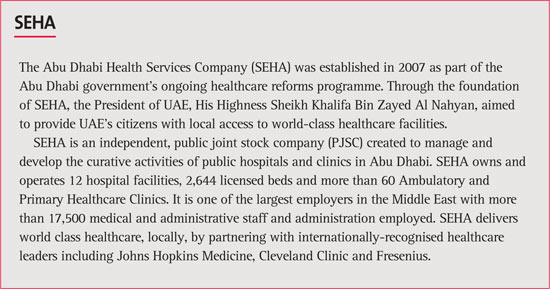
The Abu Dhabi Health Services Company (SEHA) was incorporated in 2007 to provide high quality healthcare in Abu Dhabi. As a socially and financially responsible enterprise, SEHA is committed to using public funds in the best way possible, which includes streamlining processes to optimise service delivery and enhance cost-efficiency. As this article outlines, SEHA has embarked on a flagship project to automate and improve control over payment processes to reduce costs, optimise financial integrity and ensure the timeliness and accuracy of payments to suppliers.
Project background
SEHA has 10 business entities (hospitals and centralised services) each of which manages its own finance function (including cash and treasury management) independently. Each entity has four bank accounts, resulting in 40 accounts at a group level. Before embarking on this project, it was difficult to achieve timely, accurate visibility of funds at a group level or consistency over financial processes. All cash and treasury processes, including payments, were conducted manually, requiring up to eight physical documents to support each payment. The minimum time for approving an invoice was 10 days with no ability to track the status of a payment throughout its lifecycle. Troubleshooting errors or delays (such as incomplete or incorrect payment instructions, incomplete approvals etc.) was a considerable challenge, with a high incidence of late payments, potentially harming supplier relationships, increasing risk in the supply chain and creating reputational damage.
Devising a solution
Having identified the limitations in our existing processes, we made the decision to automate our procure-to-pay process by developing a custom workflow in our ERP (Oracle) that would specifically meet our requirements. This would be integrated with our banking partner, Abu Dhabi Commercial Bank (ADCB) via a real-time, host-to-host connection.[[[PAGE]]]
We structured our workflow as follows:
- Requisitions are made by the relevant department via the ERP which are then automatically checked and validated. If the amount is within budget, the requisition is approved and automatically forwarded to the corresponding authorised signatory for approval via the ERP;
- On approval, the requisition is forwarded to procurement which obtains quotes and processes the purchase order;
- Upon receipt of the goods/ services, the receiver acknowledges the supplier’s delivery order and logs successful receipt in the ERP;
- The supplier submits the invoice to SEHA’s accounts payable department, which is archived in the document management system;
- Accounts payable matches the invoice and the corresponding goods delivery note in the ERP and sends the invoice to the end user of goods/ services electronically in ERP for approval;
- Once the invoice has been approved, payments are processed and payment files approved electronically by authorised signatories, with the ability to drill down on the transaction detail;
- Payment files are encrypted and transmitted electronically to the bank;
- The bank then sends an instant, encrypted acknowledgement to the ERP system indicating any rejections;
- The bank transmits an end of day report direct to the ERP with the status of each transaction e.g. processed or rejected.
We presented our objectives and proposed solution to executive management. As one of first companies in the region to create a custom-designed, automated payment process, this was a major step for SEHA. The solution we recommended won considerable management support, particularly due to the quality of the audit trail. At any point, a payment report can be produced from the ERP, with information on the originator, checker and approver of each payment. Invoices are automatically archived at an individual invoice and payment level, avoiding the need for manual filing and hard-copy storage.
Implementation experiences
The implementation proceeded smoothly with a high quality approach to project management, including extensive testing. This gave users confidence in the new solution, as well as processing accuracy. By designing a new workflow that met our needs exactly, we have achieved a high degree of acceptance by both internal staff and suppliers, whilst demonstrating industry best practices in process efficiency, security and resilience. These include minimal hard-copy documentation to support the payments process, paperless electronic approvals, a full audit trail of activities throughout the procure-to-pay lifecycle and encryption of electronic payments with secure transmission. These achievements were even more significant bearing in mind that SEHA was one of the first enterprises in the Middle East to develop a customised, automated workflow with a host-to-host banking connection, so we had few case studies on which to base our payments automation initiative.
New payment files are transmitted to our bank, ADCB’s designated file location, every 30 minutes. Files are retrieved and validated prior to payment, with prompt notification of rejections or queries, allowing us to make any necessary corrections without affecting the value date. This approach was more cost-effective and less resource-intensive than implementing a specialist payments system, and allowed us to develop processes that met our needs more precisely. Furthermore, we were able to leverage ADCB’s expertise in efficient payments processing. For example, ADCB provided details on the required payment formats, including advice on encryption, in order to ensure accurate, robust and secure straight-through processing.
Outcomes and benefits
We were one of the first enterprises in the Middle East to develop an automated workflow in our ERP that was specifically customised to our needs, and integrating ou ERP with our banking partner, ADCB, via a host-to-host connection. As a result of doing so, we have achieved a variety of both quantitative and qualitative benefits, including:
- Cost savings – We have achieved annual cost savings of US$ 2.4m. As SEHA is a government-owned enterprise, these funds can be better utilised for the benefit of our citizens.
- Environmental savings – We have eliminated 288,000 pages per annum from our processes, significantly reducing our environmental impact. Furthermore, some studies estimate that the associated cost of reducing paper from business processes is between 13 and 31 times the paper purchasing cost (e.g. , printer ink, cost of filing and storage etc.).
- Accelerated workflow – The invoice registration and payment processing life-cycle has been reduced from 10 days to two days, with prompt approval at each stage. This in turn reduces the number of late payments and ensures that queries can be addressed before payments become overdue.
- Enhanced payments security - The solution enables us to define specific security rules and user rights, allowing a high degree of configuration. By encrypting electronic funds transfer (EFT) files before transmitting them to the bank via a host-to-host (H2H) connection, we are able to meet industry standards for information security and safeguarding suppliers’ critical information such as banking details.
- Achieved information transparency - Payments can be tracked throughout the payment processing lifecycle allowing complete transparency and accountability. It also helps in the timely troubleshooting of errors and avoids payment delays.
- Improved cash flow forecasting – By accelerating payments processing from 10 to two days, we can position funds more accurately. Furthermore, we can smooth our cash flow cycle and reduce working capital requirements by defining regular payment cycles.
- Reduced supplier risk – By increasing the timeliness and accuracy of payments processing, and improving the experience of our suppliers, we have increased the resilience of our supply chain and enhanced relationships.
- Increased staff and patient satisfaction – We have improved the experience of internal staff by eliminating time-consuming manual steps that divert resources from core activities, therefore enabling healthcare and administrative personnel to spend more time on delivering value to our patients and achieving our government’s healthcare objectives.
- Pioneered innovation and best practices in the region - This project has been an innovative collaboration between a public-sector entity and a local bank, paving the way for other enterprises in the region to increase transparency, efficiency and security in their financial processes.
An exemplary role in Abu Dhabi
As a public healthcare provider, SEHA is one of the most prominent entities in Abu Dhabi. We recognise that developing robust and automated financial disbursement systems that improve the experience of both employees and suppliers is a critical element to becoming a world-class healthcare system. By partnering with ADCB, as opposed to a foreign bank, we have demonstrated how local banking relationships can result in world-class solutions, leading to sustainable economic growth and the flourishing of local skills and expertise. Furthermore, the success of this project is an important blueprint for both governmental and private organisations across the region as part of a wider objective to promote a culture of financial responsibility, transparency and accountability.
Future plans
As a result of the project, we are now in a position to implement further enhancements to our infrastructure, such as introducing an automated payroll processing solution, automated internal funds transfers and automated reconciliation. We are also considering implementing cash pooling solutions such zero balancing accounts (ZBAs) which will enable us to have visibility of our group cash position and optimise the use of funds across the SEHA group.